Crazy English in the New Yorker

The latest issue (April 28, 2008) of the New Yorker has an article on the China’s Crazy English (Fēngkuáng Yīngyǔ / 疯狂英语) method: Crazy English: The national scramble to learn a new language before the Olympics, by Evan Osnos.

Li Yang Crazy English (as it is properly known, after Li Yang, the company’s founder, chief spokesman, and head cheerleader) uses untraditional and emphatic but not always proven methods, including shouting and vowel-associated gesticulations, to help students overcome their fear of using English and remember the sounds of their vocabulary words.

Chinese nationalism is also a big part of its approach.

From the article:

A long red-carpeted catwalk sliced through the center of the crowd. After a series of preppy warmup teachers, firecrackers rent the air and Li bounded onstage. He carried a cordless microphone, and paced back and forth on the catwalk, shoulder height to the seated crowd staring up at him.

“One-sixth of the world’s population speaks Chinese. Why are we studying English?” he asked. He turned and gestured to a row of foreign teachers seated behind him and said, “Because we pity them for not being able to speak Chinese!” The crowd roared.

Li professes little love for the West. His populist image benefits from the fact that he didn’t learn his skills as a rich student overseas; this makes him a more plausible model for ordinary citizens. In his writings and his speeches, Li often invokes the West as a cautionary tale of a superpower gone awry. “America, England, Japan—they don’t want China to be big and powerful!” a passage on the Crazy English home page declares. “What they want most is for China’s youth to have long hair, wear bizarre clothes, drink soda, listen to Western music, have no fighting spirit, love pleasure and comfort! The more China’s youth degenerates, the happier they are!” Recently, he used a language lesson on his blog to describe American eating habits and highlighted a new vocabulary term: “morbid obesity.”

Li’s real power, though, derives from a genuinely inspiring axiom, one that he embodies: the gap between the English-speaking world and the non-English-speaking world is so profound that any act of hard work or sacrifice is worth the effort. He pleads with students “to love losing face.” In a video for middle- and high-school students, he said, “You have to make a lot of mistakes. You have to be laughed at by a lot of people. But that doesn’t matter, because your future is totally different from other people’s futures.”

Very soon Sino-Platonic Papers will be issuing a long, critical study of Crazy English. Look for the announcement of that here in Pinyin News.

further reading:

Find Chinese characters online by drawing them with your mouse

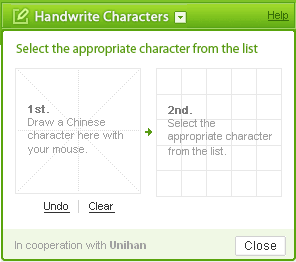
Nciku, a Web site that bills itself as “more than a dictionary,” has a nifty feature that allows users to find Chinese characters by drawing them with a mouse.

interface for the character-drawing tool

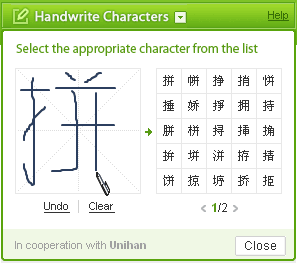
As you draw, possible character matches will appear in the box to the right of your drawing, with the results refined as your drawing progresses. You don’t need to know the canonical stroke order to get this to work, nor do your calligraphy skills need to be perfect, as this example shows.
, showing the results with a sloppily drawn ? (the 'pin' of 'Pinyin')

Once you see the correct character offered as a choice, click on it and it will be entered into the search box for the site’s online dictionary. This dictionary feature can handle multiple-character input and will even prompt you with likely choices to fill out your search.

via Keywords

video of Pinyin’s ‘father,’ Zhou Youguang, in English

Roddy of Chinese Forums, Signese, Dreams of White Tiles, and even more sites, found a new video (4 min. 40 sec.) of Zhou Youguang speaking, in English, to a reporter from the Guardian.

I was kind of surprised to see this featured on the Guardian’s front page under the ‘Father of Pinyin’ title – I’d wager 9/10ths upwards of the Guardian’s readership doesn’t know what pinyin is. Somewhat unforgivably they’ve managed to spell the guy’s name wrong and not bothered to add tones to the pinyin used in the video, and the interview is pretty weak – basically it’s ‘here’s a nice old Chinese guy talking for a few minutes’ but there’s really very little of depth. They’ve also opted to add subtitles to what sounds to me like perfectly comprehensible English.

But enough negativity, if you want to get a look at the guy who rescued you from bopomofo, have a look.

As happy as I am about the video, I’m going to add a bit more negativity. Failure to get the word parsing correct is also a major error: not “pin yin zhi fu” but “Pīnyīn zhī fù.” Actually, even that isn’t so good, because Pinyin is meant for modern baihua, not the style of Literary Sinitic and its many short forms. Thus, “Pīnyīn de fùqin” would be better.

The accompanying article is amazingly sloppy in parts.

Although the article manages to spell Zhou Youguang’s name correctly, it consistently refers to him not by his family name but by his given name, “Youguang.” It’s almost inconceivable that any reporter in China could (repeatedly) make such an elementary mistake; so perhaps this is the fault of an overzealous copy editor.

I’m not going to sort out and list what’s correct and what’s incorrect in the rest of the article, other than mention one point at the end.

Confusingly, Taiwan uses several different romanisation methods — including a variant of pinyin, tongyong pinyin — and zuiyin.

Zuiyin? Of course what is meant is zhuyin (zhùyīn/註音/注音), which is spelled correctly earlier in the article. Zuiyin (zuìyīn/罪因) is a noun meaning “cause of a crime.”

sources:

exam completed in Pinyin

This season is the thirty-first anniversary of the reinstatement of China’s national college entrance examinations after the end of the disastrous Cultural Revolution. Here’s the story of something that happened the year of the reinstatement (1977), when Zhang Huiming, a professor in the Chinese department of Xianyang Normal College, grading exams from Xianyang, Shaanxi, and its surrounding areas.

That year, after the start of the third day of work grading the exams had begun, one of the teachers on the grading team suddenly shouted in amazement, “Come look at this exam!” There before all of us was a language exam that had been answered completely in Hanyu Pinyin. Facing this situation, everyone discussed it. Right away, some said, “This is simply horsing around, putting on a show. Give it a zero!” The head of the grading team was inclined toward this idea. But Zhang Huiming insisted on first putting the exam into Chinese characters. “Who wouldn’t allow such an exam? There’s no rule against it. And Chairman Mao long ago indicted, ‘Writing should follow the world’s common Pinyin trend [i.e., use an alphabet like everyone else].’”

Everyone fell silent. Zhang Huiming took about half an hour to annotate the Hanyu Pinyin with Chinese characters. It turned out that the exam was nearly without errors in spelling or tone marks. The score, to everyone’s surprise, was 88. The teachers who corrected the exams were all convinced by this examinee of the soundness of training in Hanyu Pinyin.

A nice story. But I can’t help but note sadly that a bunch of well-educated people didn’t simply read the essay as it was written. Such are the prejudices against it. What I’d really like is a story that doesn’t treat Pinyin as if it were merely a set of training wheels.

“Gāokǎo huīfù 30 nián” zhǔtí bàodào tuīchū hòu, hěn duō dúzhě fā lái diànzǐ yóujiàn, jiǎngshù dāngnián de gāokǎo gùshi. Xiányáng Shīfàn Xuéyuàn Zhōngwénxì jiàoshòu Zhāng Huìmín, shì 1977 nián Xiányáng dìqū yǔwén yuèjuàn lǎoshī zhīyī. Dāngnián, yī fèn wánquán yòng Hànyǔ Pīnyīn wánchéng de yǔwén dájuàn ràng tā zhìjīn nánwàng.

Dāngnián, yuèjuàn gōngzuò kāishǐ hòu de dì-sān tiān, yuèjuànzǔ yī lǎoshī tūrán jīngyà de shuō: “Kuài kàn, zhè fèn shìjuàn!” Yī piān wánquán yòng Hànyǔ Pīnyīn zuòdá de yǔwén shìjuàn chéngxiàn zài dàjiā miànqián. Suíhòu, zhè fèn tèshū de shìjuàn zài quántǐ lǎoshī zhōngjiān kāishǐ chuányuè. Miànduì zhè yī qíngkuàng, dàjiā yìlùnfēnfēn. Yǒurén dāngchǎng biǎoshì: “Jiǎnzhí jiùshì húnào, biāoxīnlìyì, gěi língfēn!” Yuèjuànzǔ zǔzhǎng yě qīngxiàng gāi yìjian. Dàn Zhāng Huìmín jiānchí yīng xiān jiāng kǎojuàn fānyì chéng Hànzì. “Shuí bù ràng tā zhèyàng dájuàn? Gāokǎo bìng méiyǒu bùyǔn xǔyòng Hànyǔ Pīnyīn zuò dá’àn de guīdìng, kuàngqiě Máo zhǔxí zǎojiù zhǐshì: ‘Wénzì yào zǒu shìjiè gòngtóng Pīnyīn de fāngxiàng.’”

Chénmò le yīhuìr zhīhòu, Zhāng Huìmín yòng jìn bàn ge xiǎoshí de shíjiān, gěi zhěng fèn dájuàn shàng de Hànyǔ Pīnyīn biāozhù le Hànzì. Ràng Zhāng Huìmín nányǐ wàngjì de shì, nà fèn kǎojuàn, yīnjié, shēngdiào jīhū méiyǒu cuòwù. Jiéguǒ, zhè fèn fèijìn zhōuzhé de yǔwén dájuàn jīng gě fùzé lǎoshī píngyuè hòu, zǒng fēn jìngrán shì 88 fēn. Quántǐ yuèjuàn lǎoshī dōu bèi zhè wèi kǎoshēng zhāshi de Hàn yǔyán gōngdǐ suǒ zhéfú.

source: Yī fèn yòng pīnyīn wánchéng de yǔwén shìjuàn (一份用拼音完成的语文试卷), Huash.com, March 27, 2007

Pinyin-related plugin for WordPress

Adsotrans — which offers the best free, online Pinyin transcription tool — has just released a plugin for WordPress, the most popular software for blogging. This will annotate Chinese characters with all-important word parsing. Trevelyan’s post provides a download link and directions.

Check it out.

ChinesePod is helping sponsor this project, so they deserve thanks.

source: Our Adsotrans WordPress Plugin, Adsotrans blog, February 14, 2008

Pinyin in space

Stories about the official approval last September of the name of “Chiayi” for an asteroid/planetoid/minor planet (not to be confused with Pluto, the “dwarf planet“) discovered by astronomers with Taiwan’s National Central University drew my attention to the fact that another minor planet already bears the name of the university — and that they named it using Tongyong Pinyin: “Jhongda” (i.e., Zhōng-Dà, the short form of the school’s name in Mandarin, Guólì Zhōngyāng Dàxué).

There are plenty of planetoids bearing names in Hanyu Pinyin, e.g. Chongqing, Guangzhou, Guizhou, Beijingdaxue [i.e., Beijing Daxue], Beishida [i.e., Bei-Shi-Da], and Zirankexuejijin [i.e., Ziran Kexue Jijin].

Omitting spaces is common in the names as a whole, though some of them have spaces. And some have hyphens.

Although the statistics of diacritical characters in minor planets’ names (a list after my own heart) shows that, as of June 1997, 667 (4.83%) of the 13,805 named minor planets had diacritical characters in their names, I didn’t spot any Hanyu Pinyin names with tone marks. The mark for first tone doesn’t appear on the list even once.

I wish they’d followed Tongyong when naming asteroid Chiayi, because that way they would have ended up with the same spelling that Hanyu Pinyin uses: Jiayi. But I guess the solar system’s big enough for Wade-Giles as well.

Here are some Google search figures from Taiwan government domains.

  • 532 from gov.tw domains for “chia-i”
  • 1,380 from gov.tw domains for “jiayi”
  • 2,660 from gov.tw domains for “chia-yi”
  • 997,000 from gov.tw domains for “chiayi”

Should Ma Ying-jeou win next month’s presidential election in Taiwan, both the executive and legislative branches of government would be in the hands of the no-longer-opposed-to-Hanyu-Pinyin Kuomintang, and the national folly of Tongyong Pinyin could soon cease to exist as an official system not just in Taiwan but everywhere throughout the known universe … except on planetoid no. 145534 (“Jhongda”), a big chunk of rock in orbit somewhere past Mars.

sources:

Orality and textuality in the Indian context: SPP

The latest rerelease from Sino-Platonic Papers is Orality and Textuality in the Indian Context (1.7 MB PDF), by Ludo Rocher of the University of Pennsylvania.

An excerpt:

Friedrich Max Müller noted: “We can form no opinion of the power of memory in a state of society so different from ours as the Indian Parishads are from our universities. Feats of memory, such as we hear of now and then, show that our notions of the limits of that faculty are quite arbitrary. Our own memory has been systematically undermined for many generations.” More succinctly, the German indologist Heinrich Lüders described some Indian pandits as “nothing but waking, living text books.”

But Western scholars went further than being amazed. They also raised the question why Indians resort to memorization “even at the present day when manuscripts are neither scarce nor expensive.” Memorization is something one expects in illiterate societies, and that includes India before the introduction of script. But why did Indians continue to memorize so much, even after the time when script came to India?

The age of the introduction of script in India — rather its reintroduction after it disappeared with the Indus Valley Civilization — is still debated, and I will not touch on that problem since it is beyond the scope of this paper. Suffice it to say that there are inscriptions, all over the subcontinent, as early as the third century B.C.E., which means that Indians still resort to oral transmission more than two thousand years after they could have resorted to written transmission.

I will argue in this paper that the question of oral transmission versus written transmission in India is far more complex than it has often been presented. There are a number of factors at work, and these factors are different for different branches of the extensive literary legacy of classical India.

This is issue no. 49 of Sino-Platonic Papers. It was originally released in October 1994.

Sexism in Mandarin: a study

This week’s free rerelease from Sino-Platonic Papers is Covert Sexism in Mandarin Chinese (1.9 MB PDF), by David Moser (of Why Chinese Is So Damn Hard fame).

Here’s part of the introduction:

Like other cultures, China has a long history of sexist social conventions, and the Chinese language is pervaded with evidence of these. Research in this area has usually sought to identify and catalog aspects of Chinese that embody these sexist cultural traditions, such as sexist idioms, demeaning words for wife, derogatory terms of address for women, or the large number of characters containing the female radical (女) with negative connotations. Such elements tend to be rather easily identifiable and have been some of the earliest aspects to be targeted for linguistic reform. (The Chinese Communist Party, for example, in their attempts to elevate the status of women and eradicate vestiges of feudalism, has from time to time officially discouraged use of pejorative terms of address for women and wives.) Notable contributions have already been made in such research, but there are certain kinds of sexism in the Chinese language that are more subtly embedded in the grammar in such a way that they often escape conscious attention. This article attempts to shed light on some of these phenomena, since it is often in these hidden patterns of linguistic usage that sexist assumptions and notions are most powerfully present.

This is issue no. 74 of Sino-Platonic Papers. It was first published in January 1997.