teaching in English in Malaysia

In my previous entry I mentioned how in Malaysia students are taught math and science in English. Recently a few adjustments have been made to this policy, which began about three years ago. Here’s a little more information about this, especially as it pertains to schools in that country for ethnic Chinese.

Upper primary school pupils in Chinese schools will learn Mathematics and Science in English for two periods each.

“After discussions with all parties concerned, we have decided on a 4-2-2 formula – that is, four periods of English, two periods of Mathematics and two periods of Science in English for upper primary pupils,” said Education Minister Datuk Seri Hishammuddin Tun Hussein.

He added that to accommodate the teaching of Mathematics and Science in English, there would be one period less for Moral Education.

Chinese-medium schools have adopted a bilingual approach, teaching Mathematics and Science in both Chinese and English.

For the lower primary level, a 2-4-3 formula has been used since the policy was implemented in 2003 – two periods for English, four for Mathematics and three for Science per week.

With the announcement, upper primary pupils now have eight periods of Mathematics per week – six periods will be taught in Chinese and two periods in English.

Previously, only seven periods were allocated for Mathematics.

To make room in the timetable for the additional period, Moral Education now will be taught in four periods instead of five.

For Science, of the five periods allocated for the subject, three will be in Chinese and two in English.

The idea of using English to teach Science and Mathematics was proposed to arrest the declining command of the language among students. The policy was implemented from January 2003.

Unhappiness with this, however, apparently extends beyond the ethnic Chinese community, as four students have asked Malaysia’s High Court to declare that the teaching of math and science in English is “unconstitutional, invalid and ineffective.”

For a scholarly examination of related issues, see the work of Wong Ting-Hong (English PDF), such as his book Hegemonies Compared: State Formation and Chinese School Politics in Postwar Singapore and Hong Kong.

sources:

Some say ‘no 3Q’ to Net slang in Chinese test

Internet slang and emoticons were included in the Chinese-language section of this year’s college-entrance exam for Taiwan, to the dismay and confusion of many.

Examples of this in the exam include

  • ::>_< ::
  • 3Q
  • Orz

::>_< :: is supposed to represent crying. (The colons are tears, the underscore is the mouth, and the others are the eyes.)

For "3Q," the three is pronounced san and the Q is pronounced as in English, yielding "san Q," which is meant to represent the English phrase "thank you."

"Orz" is intended to be a pictograph of a person bowing down on the floor, with the O as the head, the vertical line of the r as the arms, and the z as the legs.

This test is crucial to the lives of those seeking to enter post-secondary education. Many students spend years studying for this exam. The nation's parents, stressed-out from worry about how their children will do on this test, will probably go ballistic over this. I'll be surprised if those questions end up being counted toward the final score.

On the other hand, I can't help but think that given how much Classical Chinese is certain to be on the test, a few questions about modern Internet slang might not be inappropriate. After all, the latter is likely to have more relevance to the majority of today's college students and even possibly more a part of modern Mandarin than some parts of literary Sinitic.

sources:

Firefox extensions for Mandarin Chinese texts

Although my favorite Web browser remains Opera (which is now free), I recognize that Firefox (which has always been free) has some nice things going for it, especially its wide range of extensions.

At least two of these extensions might be of special interest to readers of this site: Translate, which will translate a Web page from Mandarin Chinese (as well as lots of other languages) into English (more or less), and the Adso GreaseMonkey Script, which provides Pinyin and English annotation for Chinese characters.

First, Translate, which is the cat’s pajamas. I don’t know how I survived without it.

  • Using Firefox, Install Translate. (If that link has expired, find the installation through the home page of Gravelog.)
    • Firefox will likely block your installation at first, which is a good thing. (Safety first.)
    • Look for this message in a bar near the top of your browser window: “To protect your computer, Firefox prevented this site (ctomer.com) from installing software on your computer.”
    • Click on the “Edit Options” button in the same bar (near the top right of your screen).
    • A pop-up box will appear. Click on “Allow” and then “Close”.
  • Restart Firefox.
  • Try out the extension by going to a Web page with text in Chinese characters.

    From the Firefox menu, choose Tools --> Translate --> Translate from Chinese-simp[lified] (or Tools --> Translate --> Translate from Chinese-trad[itional], as appropriate). The translated Web page will appear in a few moments.

    If you want to translate just a portion of the text on a Web page, or if Babel Fish chokes on the text of the entire Web page and you need an alternate approach, simply use your mouse to select the text you’re interested in. Next, right click and select Translate --> From Chinese-simp (or Translate --> From Chinese-trad , as appropriate). Note: The translation will appear in a new tab, so don’t sit around waiting for the translation to appear in the same tab you’ve been working in.

    Translate also handles Japanese, Korean, French, German, Spanish, Italian, Dutch, Portuguese, Greek, and Russian.

    A related but less effective extension is gtranslate, which handles limited amounts of text in simplified but not traditional characters.

    Now let’s examine the Adso GreaseMonkey Script.

    • Install Firefox or upgrade to version 1.5.
    • Using Firefox, install Greasemonkey (If that link has expired, find the installation through the main Greasemonkey page.)
      • Firefox will likely block your installation at first, which is a good thing. (Safety first.)
      • Look for this message in a bar near the top of your browser window: “To protect your computer, Firefox prevented this site (greasemonkey.mozdev.org) from installing software on your computer.”
      • Click on the “Edit Options” button in the same bar (near the top right of your screen).
      • A pop-up box will appear. Click on “Allow” and then “Close”.
    • Restart Firefox.
    • Install the Adso GreaseMonkey Script.
      • Look for this message in a bar near the top of your browser window: “This is a Greasemonkey user script. Click Install to start using it.”
      • Click the “Install” button in the same bar (near the top right of your screen).

    Try it out by going to a Web page with text in Chinese characters.

    To activate the script, press “a”.
    Click on or highlight the script you’re interested in seeing the Pinyin for.
    Move your mouse over the Chinese characters in the pop-up box; the Pinyin will appear.
    screenshot of how this popup looks

    To deactivate the script, press any other key.

    For more information, see the Firefox Plugin: Chinese text annotation thread on Chinese-forums.com.

    Of related interest is the Rikai Web page converter.

    Korean brands, images, and naming

    Choe Yong-shik, the author of What’s Wrong With Korea’s Global Marketing, has some interesting comments on company names and branding in South Korea.

    He notes that in 1992 the Korean company Samsung switched its logo, changing from using the Chinese characters 三星 to the Roman alphabet (with a stylized A):
    Samsung logo

    This, he says, is representative of a trend:

    Since the 1990s, many companies have carried out similar corporate identity projects that have seen the gradual extinction of the practice of using Chinese character logos. Companies have increasingly leaned toward more appealing names in the Roman alphabet as a means to establish a global brand image.

    Using Chinese characters as an international brand image in today’s global market is not only ineffective, but it also borders on silliness.

    source: Samsung, LG’s Brand Globalization History, Korea Times, December 26, 2005

    site to tout Taiwan’s English environment bad beyond belief

    Taiwan is touting its “English living environment” with a “carnival” (i.e., a room with a bunch of booths from various government agencies and a few businesses, each with some display at least vaguely associated with English). Awards will be given; I wonder how many of them will be deserved.

    Here’s a sample from the carnival Web site’s introduction to the “mascots” for the event: American boy

    Hello! We are Mascot Profile, because theme of this year is (ENJOY TAIWAN), make us to be siblings organic to assemble to get together too. In the face of the change of the world environments, because the progress of science and technology makes the mutual distance shorten, so world has merged together already a village . In fact, Taiwan is the same too, because the plasticity of Taiwan is strong, accept degree high, already already like world village, there are various kinds of culture and characteristic . This kind of phenomenon is six of ours. Introduce myself by us right away now , see which one be most lovely!

    This machine-translated monstrosity is nothing short of a disgrace.

    As for why they need mascots, or why most of these represent people from countries where English is not the native language — that’s beyond me. Perhaps it’s to distract people from the disastrously bad English.

    For anyone who would like to attend and perhaps get to see how the “original flavor in Taiwan of Israel opens the prelude, will praise 33 excellent organs,”* the event opens today (Tuesday, December 20) at Taipei 101. For details and more atrocious English, see the Web site for the 2005 English Carnival.

    * No, I didn’t make that up either.

    Ban loan words, says North Korea

    When it’s not prompting nightmares, North Korea is often good for a laugh.

    The December 9 edition of Minju Chosun, the newspaper of North Korea’s Cabinet, editorialized on the “Culture of Language,” arguing for the importance of the “four don’ts.”

    1. Don’t use difficult Chinese phrases and other words of foreign origin. Loan words should be banned because they are “‘toxins that destroy the character and purity” of the Korean language. They also undermine the people’s sense of independence.
    2. Do not make excessive use of regional dialects. That sort of thing “creates confusion in language, hampers communication and degenerates personality.”
    3. Avoid slang and vulgar words. They cause misunderstanding and distrust and mar public unity.
    4. Don’t speak too fast. The proper speaking speed is 260-270 words per minute. If people speak too fast, it’s hard to understand what they are saying.

    Talk about the “purity” of a language is of course particularly absurd, especially considering what a large portion of Korean has been borrowed from Sinitic languages over the years. But there is a grain of truth in the assertion that borrowings from Chinese have resulted in some troubles for Korean. The problem, however, is rooted in Chinese characters rather than linguistic borrowing itself. William Hannas discusses this some in his excellent book Asia’s Orthographic Dilemma, including within a section on the so-called homonym problem.

    For nearly two millennia non-Chinese languages on China’s periphery have shared Sinitic vocabulary) freely, in a manner known to all of the world’s languages. Until recently, the direction of this “borrowing” had been largely from Chinese to Japanese, Korean, and Vietnamese, although the latter languages — most notably Japanese — have reversed the process and for the last century and a half have been coining new terms from Sinitic morphemes that are adopted by all four languages. As a result of this borrowing, more than 40 percent of Japanese, 50 percent of Korean, and at least one-third of the words in Vietnamese are based on Sinitic morphemes, according to Liu (1969:67). These figures apply to everyday vocabulary and are lower than other researchers’ counts that take in a wider corpus…. Ho Ung claims 60 percent (1974:44), and Oh claims 90 percent for some types of Korean materials (1971:26). Helmut Martin notes that in formal Vietnamese the ratio of Sinitic words can reach 50 percent; for newspapers it goes much higher (1982:32).

    In general, the share of Chinese-style words in these non-Chinese languages increases with formality and difficulty of content, which is to say, Sinitic terms dominate those environments where style and subject matter make them the least predictable. One would think that the emphasis would be on maintaining phonetic distinctions between these word forms, but the opposite is more nearly true. Since most of the terms refer to higher-level concepts, the expectation was they would be identified through writing, where phonetic characteristics matter less. Accordingly, there was less pressure to avoid homonyms and near homonyms. Another, more important reason for the homophony can be traced to the dynamics of borrowing. When a language “borrows” terms from another, it typically adapts the words’ sounds to its own phonology, which is never a perfect match. The borrowing language cannot add distinctions to the sounds of the terms it is borrowing, but it can and does ignore phonological distinctions that its own system is not equipped to handle. In the case of international Sinitic, this means dropping the tonal features that help distinguish one Chinese syllable from another.

    source: North Chides South for Dirtying Korean Tongue, Korea Times, December 18, 2005. This article also has an interesting anecdote about a North Korean general’s reaction to seeing “English” letters on a sign in the south.

    candidate numbers and literacy

    As I mentioned in the previous entry of Pinyin News, it’s election season in Taiwan. That means the streets are lined with political banners and roving trucks have been blaring candidates’ pleas for votes. This culminated last night in an orgy of loud campaign rallies. Today all is silent, as campaigning is not allowed on election day itself.

    One of the rituals marking a milestone in the campaign season is the drawing of lots to determine the order in which candidates’ names are listed on the ballot. Candidates draw the numbers themselves at local election bureaus. Sometimes they even dress in costume for the occasion.

    These numbers, however, are given a prominence that reveals their significance is far greater than just determining name order. Indeed, even if just one person is running for an office, by law (article 38 of the Enforcement Rules of Public Service Election And Recall Law) that candidate is still assigned a number (1, of course). The numbers go alongside candidates’ names on the ballots and appear prominently on essentially all campaign material, whether that be in the form of a banner, a poster, a flyer, or a package of tissue (a popular choice here). The numbers are almost always printed in red against a white background that is itself circled in red. These two campaign banners demonstrate the style:
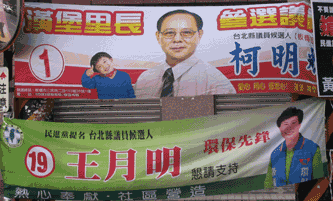
    Including the numbers is not mandated by law, but they’re always there (except in the few cases where someone overlooked writing in the number on individual signs printed before the drawing of lots). Furthermore, this style of writing the numbers is not required, but it’s seldom altered. Sometimes the color is altered to match the color scheme of the banner. But I’ve never seen a number in a square, a triangle, or a diamond — always a circle. And I’ve never seen the numbers written in Chinese characters (一, 二, 三, 四, 五, 六, 七, 八, 九,十, etc., or the more formal forms 壹, 貳, 叄, 肆, 伍, 陸, 柒, 捌, 玖, 拾, etc.) rather than 1, 2, 3, etc.

    Here’s what the Public Officials Election and Recall Law states about what information appears on ballots:

    The ballot shall bear the serial numbers [i.e., the numbers I’ve been discussing], names and photographs of all candidates. However, in an election of central public officials, the ballots shall also bear the candidates’ party affiliation from which the candidates were recommended (article 60 ).

    So the numbers also appear on the ballots themselves, which is, of course, the whole reason for them appearing in campaign literature. Note that ballots for local-level elections omit mention of political parties. Thus, not only the photo of the candidate but also the candidate’s number is regarded as more important than party affiliation.

    I think the attention given to numbers should prompt questions on the true state of literacy in Taiwan.

    I asked an official at the Central Election Commission about why party affiliation was left off. But neither he nor anyone else in his office at that time knew the explanation. And when I asked about the prominence of numbers, the official admitted that literacy did play a role in this.

    For what it’s worth, party affiliation on ballots for national-level posts is indicated by the printed name of the party, not with a party logo. A change to logos is being discussed for the next legislative election.

    There’s a lot more to be said about this topic. Perhaps I’ll come back to it later.

    The UN says:

    In countries with high rates of illiteracy, election management bodies should design ballots that include party emblems or photographs of candidates in order to facilitate voting. If there are minority languages in a country, it is good practice to print ballots and voter education material in all the languages commonly used.

    In Afghanistan, where literacy is low, ballots have not only the names of candidates but also their photos and an assigned icon. Here’s a small sampling of these icons:

    Here’s the full list to be used on ballots in Afghan elections.)

    What’s the situation in other developed countries?

    A story in the Miami Herald from 2004 states that in Florida
    http://www.libertypost.org/cgi-bin/readart.cgi?ArtNum=54875
    “using numbers has a long history here [in Miami-Dade County, Florida], where illiteracy is not uncommon.”

    “Miami, FL, Jun. 23,[ 2004] (UPI) — Miami-Dade County, Fla., is suing the state for refusing to allow placing numbers next to ballot questions and candidates to help illiterate voters…. Miami-Dade County Commissioners say the numbers next to candidates’ names and ballot proposals help the illiterate because it makes it easier for them to identify the candidate they want by number.”
    http://washingtontimes.com/upi-breaking/20040623-115105-2336r.htm

    Taipei Times story of candidate using other people’s photos (without permission or attribution) on his campaign lit:
    http://www.taipeitimes.com/News/taiwan/archives/2005/11/30/2003282303/print

    Also talk about arty b&w images of Mayor Ma on people’s posters.

    Further reading:

    English edging out Japanese in science — even in Japan

    A recent article in a Japanese newspaper discusses the dominance of English in the world of science, specifically in Japan. It contains this telling anecdote:

    Earlier this year, the Japan Society for Bioscience, Biotechnology and Agrochemistry revised the rules governing submission of papers to its Japanese-language journal, Kagaku to Seibutsu (Chemistry and Biology), as follows: “Papers should be those whose contents cannot be explained properly in languages other than Japanese, or those that are of particular interest to Japanese readers.”

    Akinori Ota, 57, a professor at the University of Tokyo’s Graduate School of Agricultural and Life Sciences who participated in making the revision, says papers likely to draw attention from around the world should be submitted to its English journal, Bioscience, Biotechnology and Biochemistry.

    “It isn’t that we don’t encourage researchers to write papers in Japanese. However, papers written in Japanese are not widely read overseas,” Ota says. The society has already returned some papers to their authors together with advice to write them in English. No papers that would be appropriate for publication in Japanese have been received.

    (Emphasis added.)

    source: Japanese scientists use English or get the silent treatment, Asahi Shimbun, November 5, 2005.