Taiwan gov’t to subsidize ‘mother-tongue’ education in kindergartens

“Mother-tongue language education” is a phrase used to mean the languages of Taiwan’s tribes and the Sinitic languages of Taiwan other than Mandarin.

The Ministry of Education is now offering subsidies for kindergartens to promote mother-tongue language education nationwide. The ministry is now accepting applications from up to 50 kindergartens for subsidies worth NT$70,000 (US$2,188) each. Ministry officials said they hoped that mother-tongue language learning would start at a younger age so that kids in kindergarten could learn to listen to and speak native languages through stories, songs and other activities. They would also learn to appreciate Taiwanese culture at a younger age, officials said. The ministry will offer subsidies for Hoklo (commonly known as Taiwanese) and Aboriginal languages, while Hakka subsidies will be given according to Council of Hakka Affairs rules. The plan is expected to be carried out starting in the fall semester of this year, officials said.

source: Language funds offered, Taipei Times, April 11, 2006

smuggler learns importance of proper Pinyin

A 28-year-old Taiwanese woman has been arrested in Hong Kong on charges of drug smuggling. Customs officials there found that the woman, who had arrived from Cambodia, had 3 kg of heroin hidden inside preserved plums. (I have a hard time thinking of these as “prunes” because they are so different than the U.S. prunes I grew up with — or rather avoided as best I could as I was growing up.)

One of the things that alerted the suspicions of the officials was that the lettering on her seven packages of plums (chénpíméi, 陳皮梅) read, in part, “Cnan.”

Yī míng 28 suì Táiwān nǚzǐ, jiāng zhěngzhěng 3 gōngjīn de hǎiluòyīn cáng zài 300 duō kē chénpíméi lǐ, zhǔnbèi yóu Jiǎnpǔzhài yùnsòng dào Táiwān fàn shòu, túzhōng zài Xiāng Gǎng jīchǎng bèi hǎiguān dāngchǎng dǎizhù, bèi jīyā zài Xiāng Gǎng kānshǒusuǒ, wànyī zuìmíng chénglì, xiánfàn jiāng miànduì 10 nián yǐshàng de yǒuqī túxíng.

Xiánfàn shì yī wèi cóng Jiǎnpǔzhài dào Xiāng Gǎng de 28 suì Táiwān nǚzǐ, jìhuà jiāng dúpǐn yùnsòng dào Táiwān fàn shòu, zhěngzhěng 3 gōngjīn de hǎiluòyīn jiàzhí 560 wàn yuán, qiǎomiào de cáng zài 300 duō kē chénpíméi lǐ, kěshì yīnwèi bāozhuāng shang “chénpíméi” de Yīngwénzì pīncuò le, yǐnqǐ Xiāng Gǎng hǎiguān de huáiyí, jiēfā zhè qǐyùn dú àn.

Xiāng Gǎng hǎiguān jiāndū Lǐ Zhāngróng biǎoshì, xiánfàn bǎ chénpíméi zhōngjiān de hé[tao] wā chūlai shōucáng hǎiluòyīng, dànshì yóuyú chénpíméi Yīngwén pīnyīn shì Chan, fàndú jítuán pīnchéng cnan, zāodào hǎiguān rényuán huáiyí dàibǔ.

Mùqián zhè wèi Táiwān xiánfàn bèi Xiāng Gǎng jǐngfāng yǐ fànyùn wēixiǎn yàowù zuì, jīyā zài Xiāng Gǎng de kānshǒusuǒ, 4 yuè 24 rì jiāng zài Xiāng Gǎng fǎyuàn jiēshòu shěnxùn, wànyī zuìmíng chénglì, xiánfàn jiāngyào miànduì 10 nián yǐshàng de yǒuqī túxíng.

sources:

Taipei mayor calls for more Mandarin, less English and Taiwanese in primary schools

According to one of the stories on this, the Taipei City Government’s Department of Education did a study comparing the amount of time sixth-graders spent on Mandarin classes in several countries. In Taiwan the figure is between 80 and 133 hours. In China the figure is 172 hours. And in Singapore the number is between 80 and 200 hours. As a percentage of the population, however, I would expect Taiwan to have the highest number of fluent or native speakers of Mandarin. On the other hand, Chinese characters are difficult for everyone.

Ma’s call is probably aimed not just at boosting Mandarin but at edging out the teaching of Taiwanese and Hakka (which may not be able to be reduced without eliminating their teaching altogether). This also sounds like another move to increase the amount of Literary Sinitic (Classical Chinese) in the classroom, which would certainly be a move in the wrong direction.

I suspect, though, that calls from parents, who often place more value on English than on other courses, will put an end to this. And anyway, in Taiwan it’s the central government that sets educational policy.

sources:

UN has been using only simplified characters for years: Taiwan foreign ministry

In my earlier post on a report that the United Nations would drop the use of traditional Chinese characters, I wrote, “I hadn’t known the U.N. was still using traditional characters at all.”

According to a release from Taiwan’s Ministry of Foreign Affairs (MOFA) yesterday, the U.N. has not used traditional characters for years. The story led the Taiwan News today:

When Taiwan’s representative office in New York checked on the report with the U.N., officials from the Department of the U.N. Secretariat said they were not informed of the report and felt puzzled by it, the [MOFA] statement said.

Although the U.N. uses Chinese, English, French, Spanish, Arabic, and Russian as its official languages, the decision has not deterred the development of other languages, such as Japanese, German, or Portuguese, the statement added.

The conservation of culture in countries using these languages was also unaffected by the U.N.’s language policy, the statement said.

Overseas Chinese Affairs Commission Vice Minister Cheng Tong-hsing said yesterday at the Legislature that the government has plans to call press conferences and various publicity campaigns to boost public awareness of the significance of using traditional Chinese characters among Taiwanese and overseas Chinese.

Minister of Education Tu Cheng-sheng (杜正勝) also said that due to the language’s historical and cultural significance, the MOE is firm in its stance that traditional Chinese characters will continue to be taught in local educational institutions regardless of the U.N.’s decision.

The Taipei Times‘ report was more cautious:

Tu said that the education ministry was in the process of verifying the UN’s plans.

It appears there’s something fishy (xīqiāo) going on, as the foreign ministry put it.

sources:

Chinese characters and left-handers

I came across an article earlier on myths about left-handedness. The section labeled “oppressing the left” notes that “lefties have long suffered.” One of the statements made in support of this, however, is that “Chinese characters prove extremely difficult to write with the left hand.” I’ve heard this assertion about Chinese characters before, many times.

Certainly there’s been a great deal of discrimination against left-handed people in China and Taiwan, where they are often forced to switch. This happens even more frequently in those two countries than in the West, where it almost certainly continues to occur. (When I was in second grade my teacher tried to force me to use my right hand. Fortunately for me, my left-handed father came to school to set her straight on this. )

Oddly enough, people in Taiwan and China have often remarked to me that left-handed people are especially smart.

I have none-too-beautiful handwriting when it comes to Chinese characters. My handwriting in the Roman alphabet, however, is pretty good when I’m writing for someone other than myself. But I doubt the difference has anything to do with me being left-handed. I didn’t grow up endlessly practicing how to write Chinese characters; also, I simply don’t care.

I’d like to note a few things.

  • For thousands of years, until well into the twentieth century, the standard order for Chinese texts was top to bottom and right to left, which, if it benefits anyone, would seem to benefit left-handed people.
  • Throughout most of their history, Chinese characters have most often been written with a calligraphy brush (maobi). And in calligraphy the brush is held perpendicular to the paper, so there’s no slant beneficial to people writing with one hand or the other.
  • Most writing with a brush is still done top to bottom and right to left.
  • Since pencils and pens produce lines of even thickness, there doesn’t seem to be anything inherently different in writing Chinese characters with these than writing the Roman alphabet, something left-handed people can do just fine.

So what, other than prejudice, is the source of the contention that left-handed people are at a significant disadvantage when it comes to writing Chinese characters?

Before anyone mentions stroke order, however, I’d like to note that is also largely a convention, not something inherent in the final appearance of the character. Otherwise, there wouldn’t be variations in stroke order, even today, especially between China and Japan.

I’m inclined to believe that this is just another of the many erroneous claims about Chinese characters, but I’d certainly be interested in hearing any evidence to the contrary.

source: What Makes a Lefty: Myths and Mysteries Persist, Live Science, March 21, 2006

titallative zhuyin — screenshots

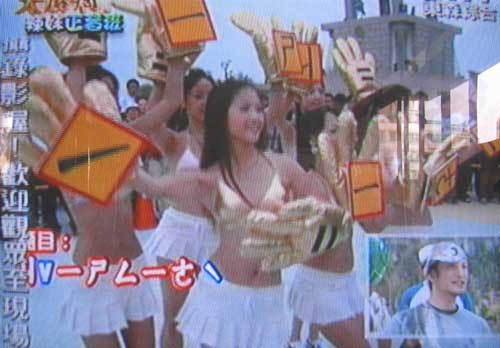
click for larger image of scantily clad dancers displaying signs with zhuyin fuhaoI finally got to see the “spicy girls pronunciation class” (“là mèi zhèngyīn bān” / 辣妹正音班), which was lucky because the replay time was different than announced. The segment began about 1:15 p.m. on Sunday.

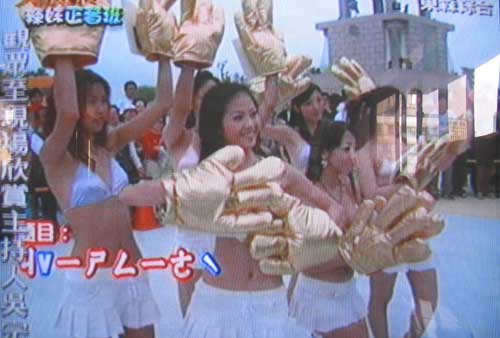
Here’s how it works. About half a dozen la mei strut out to the tune of “Dragostea Din Tei” (a.k.a. “The Numa Numa Dance”). The zhuyin fuhao and separate tone marks are affixed to cards attached to enormous, gloved hands. As they dance, the women occasionally flash the zhuyin at the contestant, who is supposed to figure out what the scrambled zhuyin spell out.

Now you see ’em.
revealing the zhuyin

Now you don’t.
hiding the zhuyin

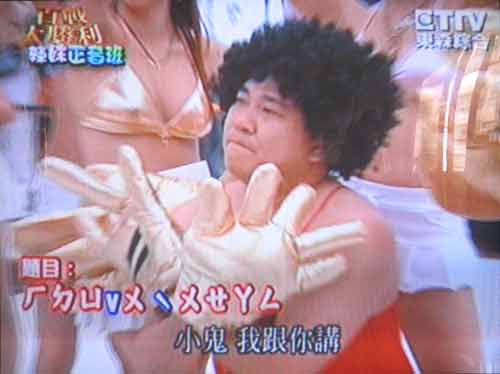
And, of course, what’s a Taiwan variety show without an overweight man in drag thrown in for comic effect?
Taiwan TV -- man in drag

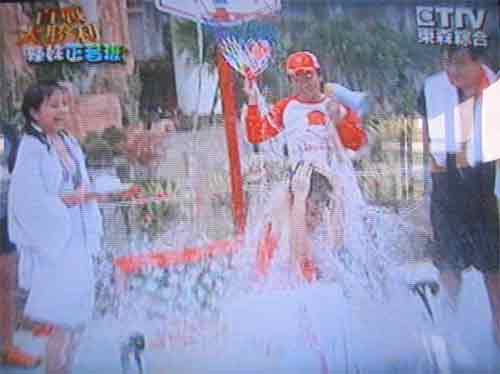
Failure to read the word or phrase in question in time results in a throrough soaking — for the contestant, not that dancers, that is.
unsuccessful TV show contestant is doused with water

englsh sirtifficates — and korrekshuns

The Jilong City Government marked Children’s Day on Tuesday by awarding certificates of merit to a number of elementary school students.

The English on the certificates read:

Congratulate you being a model student. Studying is the way to success. effort is the base of harvest. You can get this honor because of diligence, enthusiasm and politeness. We are pround of you and hope you will keep working hard to devote to the society in the future.

Of course people noticed the mistakes. A newspaper pounced on the story and listed what it said were all of the errors. A revised version, after the newspaper’s corrections, would yield:

Congratulates you on being a model student. Studying is the way to success. Effort is the base of harvest. You earn your honor because of diligence, enthusiasm and politeness. We are proud of you and hope you will keep working hard to devote to the society in the future.

This, of course, is a pathetically poor “correction.” But that didn’t stop other news outlets from repeating this.

Keelung’s Dong Sing [Dongxin] Elementary School, whose teachers were responsible for the English text on the certificates, admitted that the whole process had been very rushed and that there had been no proofreading of the certificates.

The Keelung City Government also said it would recall all of the certificates and would reissue a revised version as soon as possible.

sources:

South Korea’s ‘English villages’

English continues to expand in South Korea, which is now home to “the world’s biggest English immersion camp,” according to an article from Agence France-Presse.

Speaking Korean is banned in this English-only village that has sprung up somewhat incongruously from the paddy fields of this rice-growing region north of Seoul as part of a linguistic experiment pioneered in South Korea.

“The rule is to speak English,” said Chicago-born Glensne to his shy and giggling pupils as they shuffled between their kitchen tables and his desk to ask in English for cooking materials to make Mexican nachos….

The Paju English village is more than a language theme park. It is a real village of bricks and mortar modeled on an English village where hundreds of people live, eat, sleep, shop and learn.

It sits on a 277,000 m2 plot of land, the world’s biggest English immersion camp, boasting its own brewery pub, bookstore, bakery, restaurant, bank and theater along a main street that leads to a big domed-city hall.

Electric trams run through the main boulevard, which branches off to classrooms and houses to accommodate 100 teachers and 70 staff from various English-speaking countries and 550 students. Korean is outlawed and even written signs are banned.

“We wanted to create an environment where students feel they left Korea behind,” said Jeffrey Jones, head of the Paju camp.

Jones, former head of the American Chamber of Commerce in Korea, said Koreans really need a change to their English education which focuses too much on grammar, reading and vocabulary.

“They spend a lot of time learning English. They can read probably better than I can, but they have trouble speaking,” he said. “One of the things we do here is we break the wall of fear. They learn not to be afraid and they learn to speak.”

I found this part especially interesting:

English proficiency has become increasingly important for Korean job seekers. Interviews conducted in English are common at big-name companies like Samsung Electronics, Hyundai Motor and LG Philips.

source: English only in South Korea’s teaching towns, AFP, April 5, 2006