Script differences complicate matters for Uzbeks in Kyrgyzstan

Ethnic Uzbeks in southern Kyrgyzstan are reportedly suffering from problems with the education system, including that Uzbekistan has switched to the Latin alphabet but Kyrgyzstan has not.

Kyrgyzstan is home to more than 766,000 ethnic Uzbeks out of an overall population of roughly 5 million, according to figures compiled by the State Statistics Committee. Although their numbers are slowly declining, Uzbeks remain the largest minority group in the country. Today, there are just 14 Uzbek language schools in Osh, compared with 21 in 1991….

A shortage of Uzbek-language textbooks and teaching materials constitutes another large obstacle. Many children in Uzbek-language schools must use textbooks that were published in Uzbekistan during the Soviet era. “The situation [became] complicated after Uzbekistan changed from using Cyrillic and started using the Latin [alphabet] in 1993,” explained Erkin Bainzarov, the editor of the Uzbek section of the Osh Shamy (“Evening Osh”) newspaper. “As a result, Kyrgyzstan’s Uzbek schools were forced to stop using textbooks published by Tashkent,” and must rely on antiquated materials. Teachers in Kyrgyzstan have not adapted to the Latin alphabet.

To help, the Kyrgyz-Uzbek University, the only university in the country to provide instruction in Uzbek, established a Textbook Development Center in 1997 with the help of Batyrov’s Friendship of Peoples University in Jalalabad.

“Since Uzbekistan switched to Latin, we started developing our own [Uzbek] textbooks [written in Cyrillic],” said Tursunbai Kamilov, the director of the center. “Since 1997, we have developed a set of seven textbooks for the primary school and 20 textbooks for secondary and high schools.” Yet more is needed. Kamilov says that due to inadequate financing, Uzbek schools only have 34 percent of the textbooks they need.

Some representatives of the Uzbek community say that if current trends persist, southern Kyrgyzstan’s Uzbek-language educational structure could experience a complete collapse. “We have to maintain our schools, and have our children go to Uzbek language schools to preserve our language, culture and identity,” said Khalturaev, the school principal.

source: Kyrgyzstan: Uzbeks in Southern Regions Wrestle with Cultural Dilemma, Eurasianet, October 27, 2009

further reading:

Taipei County switches to Hanyu Pinyin

Street signs in Taipei County are beginning to be changed to Hanyu Pinyin. For Pinyin supporters here, this is a long-awaited development.

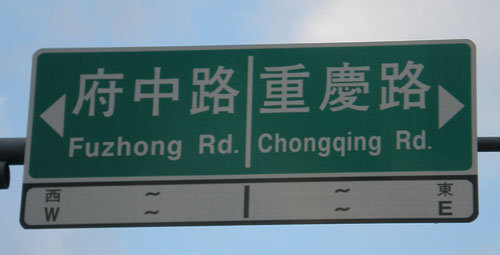
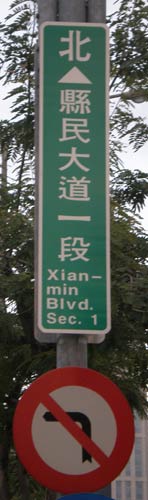
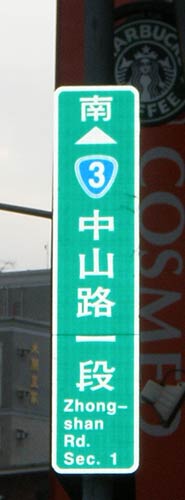
Here are some examples of new signs in Banqiao, the seat of the Taipei County Government. They were taken near the Fuzhong MRT station.

street sign in Banqiao, Taiwan, in Hanyu Pinyin: 'Fuzhong Rd.' 'Chongqing Rd.'

Xianmin Blvd. Sec. 1 (This is a vertical sign, too narrow for 'Xianmin' on one line, so it's hyphenated, with 'min' on the second line)

Zhongshan Rd. Sec. 1

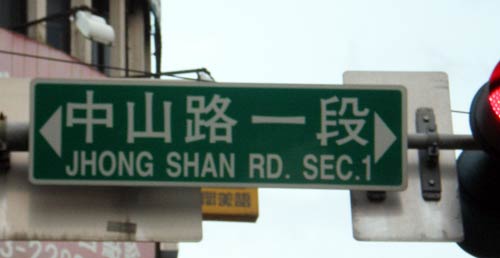
This is one of the Tongyong signs about to be taken down. It’s at the same intersection as the “Zhongshan” sign at above right. [November 17 update: The sign is now gone.]
JHONG SHAN RD. SEC.1

The first roads to receive these signs are large ones, especially those connecting one city to another. This is probably going to be a long, slow process, which is certainly to be expected given (a) how damn long it took them to get this started and (b) that most signs never got changed to Tongyong Pinyin during the previous administration. My impression is that most street signs in Taipei County, especially in smaller towns and on smaller roads, remain in MPS2 (the Tongyong Pinyin of the 1980s).

Has anyone noticed any changes yet in Xindian, etc.?

I wish I could provide links to official announcements, etc. But so far I haven’t been able to find any. I have, however, spoken with officials from the county government who confirm the new policy, so I’m going ahead and announcing this here.

Nice to see no InTerCaps. Unfortunately, the apostrophe situation is SNAFU, with those responsible for the signage using outdated guidelines (calling for a hyphen instead of an apostrophe). But I’ve forwarded the central government’s current rules on this to those concerned, which I hope will help get the problem fixed before any such signs go up.

Simplified or traditional characters for Malaysian heritage zone road signs: poll

Parts of Penang, Malaysia’s George Town are scheduled to get some new street signs that will include Chinese characters. (Penang has a high concentration of ethnic Chinese.) Controversy over whether to pick traditional Chinese characters or simplified Chinese characters has led authorities there set up an online poll to help resolve the matter.

Voting began today and will continue until Sunday, October 25, at www.heritageroadsign.com.

The site also provides some photos of signs.

The signage project, which involves putting up a total of 300 bilingual road signs on 82 roads, is expected to cost RM45,000 (US$13,400, or about US$45 per sign).

source: Online poll to pick Chinese road signs, The Star, October 10, 2009