‘write the fancy’, Taiwan tells foreigners

In line with yesterday’s remarks on the Taiwan government’s absurd approach to communicating with foreigners by putting up websites in poor English, here’s something from Taiwan’s National Police Agency, which is part of the Ministry of the Interior.

text reads 'What a Fancy Taiwan! Write the fancy. Win a camera!'

Do you think what the most unique part of Taiwan is? Except in Taiwan you will never see the following in the whole world, 101 Building, Gods of folk religion or aboriginal teenagers. If you are a foreigner living here, before November 30, 2006, please write an essay telling us what your coolest experience is in Taiwan and you might win a new digital camera.

In Forumosa’s thread on this, the poster “redwagon” has perhaps said it best:

image of Taiwan with four figures: a Taiwanese opera singer, an aboriginal teenage girl, a rice farmer, and a kung-fu guy

OMFG. Finally some of our tax money gets spent on something useful. Our entertainment.

If I didn’t know for a fact that it’s not possible to register a .gov.tw domain privately, I’d have thought it was a send up.

Or, maybe it’s a trap, in the ‘hundred flowers’ style. They aim to trick us to send our rants in, blinded by our lust for cheap digital cameras, and then deport us for not appreciating Taiwanese culture.

There’s still almost a week left in which to submit your own entry. A number of the more sarcastic entries remain, probably because those in charge of the site have no idea what’s going on.

source: What a Fancy Taiwan!, accessed November 24, 2006.

Taiwan’s “more amiable English services”

logo to promote Taiwan's English-language environment; an image of the island of Taiwan appears with a smile and a large A+, with a globe in the backgroundWith the end of the year approaching, it is once again time for Taiwan to tout the quality of the island’s English environment by putting together a “carnival” and tossing online a website in awkward English.
Perhaps word got back to the powers that be that the English in last year’s site was bad beyond belief, because this year’s site to promote English has largely left out use of that particular language! Much of the English that is there, while not so howlingly inept as that in last year’s site, is still awkward, clichéd bullshit. Here’s an example:

The Logo features close affiliation between the globe and the smiling Taiwan, symbolizing Taiwan’s linkage to the world. The expression of “English-friendly Environment” that circles the globe and the sign of “A+” on Taiwan fully convey the ideas of creating a quality and friendly internationalized environment, as well as broadening the scope of social participation. To advance Taiwan’s connection with the world, and provide better services to foreign friends who visit Taiwan, the Research, Development and Evaluation Commission of the Executive Yuan is going to use the Logo as the basis to design a emblem that identifies a quality English-friendly environment, which will be advertised and promoted through a certificating mechanism, in order to increase the number of popular locations that offer quality English services, so that foreign friends can not only easily identify those locations but also get access to more amiable English services.

One of the few parts of the site with any useful information is the page of “Important Achievements of Creating an English Living Environment.” Some of the things listed there even are important achievements. Nonetheless, Taiwan has many fundamental problems with its approach to English — and to romanization, too. One of the biggest of these problems is that English and romanization are treated as last-minute details of little importance.

I could go on and on about this; but it’s all too depressing.

source: 2006 English Carnival

story in Pinyin

Zhang Liqing has submitted another item written in Hanyu Pinyin. This time it’s a story, “Lā Tuǐ,”, by Táo Dàzú (Christopher L. Potter).

Here’s the opening:

Wǒ xiǎng gěi nǐ jiǎng yī ge zhēnshí d gùshi. Wǒ shíjiǔ suì d shíhou, Yuènán Zhànzhēng jiéshù bù jiǔ. Wǒ juédìng bù huí dàxué niànshū, yīnwei wǒ bù zhīdao wèishénme yào niànshū. Dìqiú hěn dà, měi gè rén dōu huì yǒu hǎo duō jīhuì. Qíshí shì wǒ bù zhīdao wǒ yào xué shénme zhuānyè huòzhě jiānglái zhǎo shénme gōngzuò. Zǒng’éryánzhī, wǒ bù zhīdao wǒ zhè yī bèizi yào zuò shénme. Nà gè shíhou wǒ xiǎng “bù zhīdao” shì hěn yánzhòng d wèntí. Yúshì wǒ juédìng táobì wǒ èr-niánjí d qiūjì xuéqī.

You can read the entire story on this site. Enjoy!

And the language used for the PRC side is …

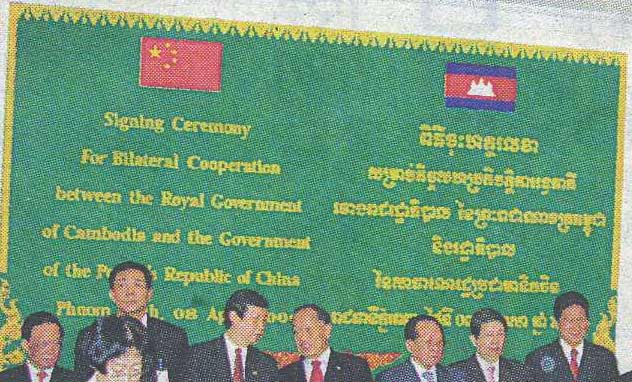
Mark Liberman of Language Log has just added another to the series of Victor H. Mair’s guest posts on English in China. This one features an interesting news photo from the ceremony for the signing of an agreement between China and Cambodia.

photo of banner for a signing ceremony between Cambodia and China, with the text for China given in English, not Mandarin; click for larger image

And I wonder what language the agreement is in.

As Mair, who is also an occasional contributer to Pinyin Info, wrote in his initial post:

Judging from all that I have seen and heard during the last couple of years, however, it is apparent that the role of English in China will continue to grow at an exponential rate. The implications of this massive expansion of English in China will inevitably have a corresponding impact upon local language usage. In fact, the profound effects of the current surge in English usage upon Mandarin and other Chinese languages is already obvious in many respects.

sources:

only 33% of Chinese small businesses use computers: study

Only 33 percent of small businesses (1-99 employees) in China have a computer, according to a recent study by Access Markets International.

China’s low rate of PC penetration among small businesses, however, is higher than that of some other highly populous countries in Asia, namely the Philippines at 24 percent, India at 22 percent, and Indonesia at 18 percent.

About 40% of the non-PC SBs in India, over a third in China, and about a quarter each in Indonesia and the Philippines have expressed their intent to buy PCs in the next 12 months….

Most of the non-PC SBs in these four countries are small — with 1-9 employees each. The bulk of SBs in these countries belongs to the wholesale and retail vertical sector. The exception is China, where more than 50% of non-PC SBs are in the manufacturing vertical.

What hinders them from buying PCs? The primary hurdle is the belief that PCs are not relevant to their line of business. About 30% of non-PC SBs in India and 14% in China told AMI that they just have not thought about buying PCs. A significant portion of SBs believe that a simple fax and phone is enough for their business. Lack of knowledge about the installation and operation of PCs is also a powerful deterrence.

source: Huge untapped market for non-PC SBs opening up, AMI Partners, November 13, 2006

via Most Small Chinese Businesses Don’t Use Computers, China Tech News, November 20, 2006

make romanizations, not war

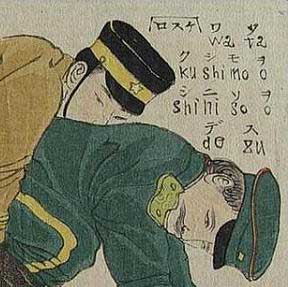
closeup of the romanization discussed in this postWhile a lot of things might be unusual about this old print of a Japanese soldier having sex with or simply raping a Western soldier, what particularly startled me is the use of romanization. Given that much of the text in the full image (note: definitely not safe for work) isn’t accompanied by romanization, it appears the intent is to help indicate which lines are being said by the Westerner. (But I can’t read Japanese, so I don’t know for sure.)
Has anyone noticed this practice — the romanization, y’all — in other Japanese prints?

Commenters on Eros Blog (again, not safe for work) translate the text and place the cartoon from the time of the Russo-Japanese War of 1904–05.

Taiwan’s MPS2 romanization system is not the same as Yale

Taiwan does not now nor has it ever officially used the Yale romanization system. But that hasn’t stopped the relatively common belief that the Yale romanization system for Mandarin can be found on some official signage here.

What most people take as Yale is in fact MPS2, a Taiwan-devised romanization system that dates from the mid 1980s. MPS2 was developed Taiwan in a vain attempt to counter the growing popularity around the world of Hanyu Pinyin. In other words, it was basically the Tongyong Pinyin of the 1980s, though its supporters (there must have been some) never embraced it with the same level of nationalistic fervor as Tongyong Pinyin has received from some quarters. Little wonder, then, that most people — including many who really should know better — don’t seem to have noticed that MPS2 even exits, much less that a great deal of the island’s signage remains in this system.

To some degree the confusion of MPS2 for Yale is understandable, given that the two systems have many points in common on which they differ with Hanyu Pinyin. Here are some examples.

-au rather than -ao

MPS II and Yale Hanyu
au ao
bau bao
chau chao
dau dao
gau gao
hau hao

-ung rather than -ong

MPS II and Yale Hanyu
chung chong
dung dong
gung gong
hung hong

chr, jr, r, shr

MPS II and Yale Hanyu
chr chi
jr zhi
r ri
shr shi

ts- instead of c-

MPS II and Yale Hanyu
tsai cai
tsan can
tsau cao
tseng ceng
tsou cou
tsu cu
tsung cong
tsz ci

And neither uses Hanyu Pinyin’s abbreviated vowel forms (such as -ui for -uei, -iu for -iou, and -un for -uen). But here we can begin to see some of the differences between MPS2 and Yale.

MPS II Yale Hanyu
chuei chwei chui
duei dwei dui
tzuei dzwei zui

Yale often uses w as a medial where other systems would use u.

MPS II Yale Hanyu
shuei shwei shui
suan swan suan
guang gwang guang

Yale often uses y as a medial where other systems would use i

MPS II Yale Hanyu
jia jya jia
niau nyau niao
chiung chyung qiong

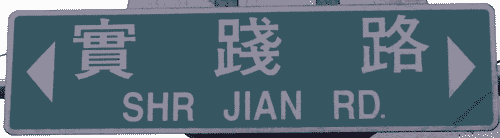
This sign, in Banqiao, would read Shrjyan in Yale, not Shrjian, which is MPS2.
street sign reading 'SHR JIAN RD'

To review all of the similarities and differences among these and other systems, see my comparison chart of romanization systems.

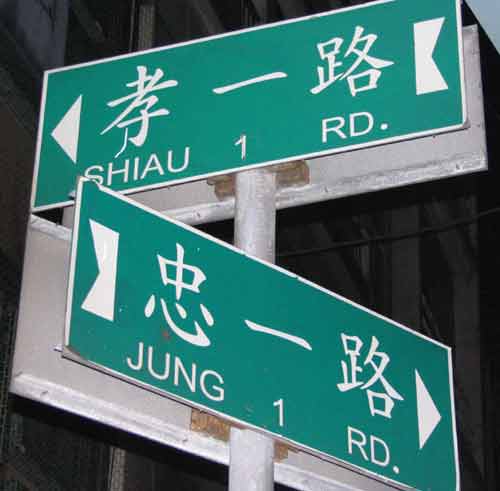
To close, here are some more signs in MPS2. What in Hanyu Pinyin is written zhong is jung in both MPS2 and Yale. What in Hanyu Pinyin is xiao, however, is written differently in MPS2 and Yale: shiau and syau, respectively.

photo of street signs in Jilong. One sign reads 'JUNG 1 RD', the other 'SHIAU 1 RD'
This photo was taken in Jilong.