
Google Translate has a new function: conversion to Hanyu Pinyin, which would be exciting and wonderful if it were any good. But unfortunately it’s terrible, all things considered.
What Google has created is about at the same level as scripts hobbyists cobbled together the hard way about a decade ago from early versions of CE-DICT. Don’t get me wrong: I greatly admire what sites such as Ocrat achieved way back when. But for Google — with all of its data, talent, and money — to do essentially no better so many years later is nothing short of a disgrace.
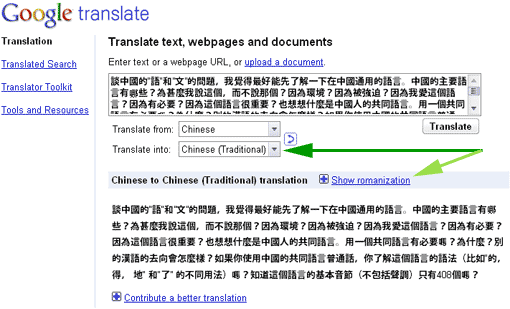
To see Google Translate’s Pinyin function in action you must select “Chinese (Simplified)” or “Chinese (Traditional)” — not English — for the “Translate into” option. And then click on “Show romanization”.
For example, here’s what happens with the following text from an essay on simplified and traditional Chinese characters by Zhang Liqing:
談中國的“語”和“文”的問題,我覺得最好能先了解一下在中國通用的語言。中國的主要語言有哪些?為甚麼我說這個,而不說那個?因為環境?因為被強迫?因為我愛這個語言?因為有必要?因為這個語言很重要?也想想什麼是中國人的共同語言。用一個共同語言有必要嗎?為什麼?別的漢語的去向會怎麼樣?如果你使用中國的共同語言普通話,你了解這個語言的語法(比如“的, 得, 地“ 和“了” 的不同用法)嗎? 知道這個語言的基本音節(不包括聲調)只有408個嗎?
Google Translate will produce this:
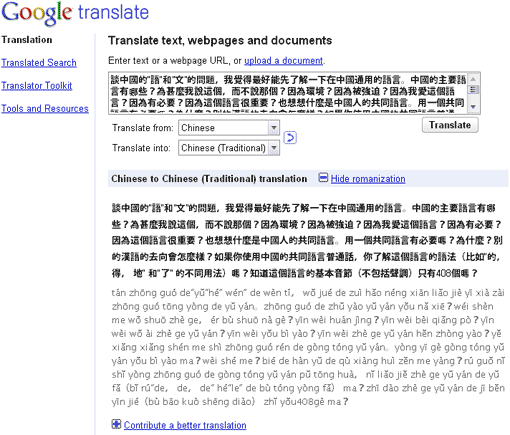
tán zhōng guó de“yǔ“hé” wén” de wèn tí, wǒ jué de zuì hǎo néng xiān liǎo jiè yī xià zài zhōng guó tōng yòng de yǔ yán。zhōng guó de zhǔ yào yǔ yán yǒu nǎ xiē?wéi shèn me wǒ shuō zhè ge, ér bù shuō nà gè?yīn wèi huán jìng?yīn wèi bèi qiǎng pò?yīn wèi wǒ ài zhè ge yǔ yán?yīn wèi yǒu bì yào?yīn wèi zhè ge yǔ yán hěn zhòng yào?yě xiǎng xiǎng shén me shì zhōng guó rén de gòng tóng yǔ yán。yòng yī gè gòng tóng yǔ yán yǒu bì yào ma?wèi shé me?bié de hàn yǔ de qù xiàng huì zěn me yàng?rú guǒ nǐ shǐ yòng zhōng guó de gòng tóng yǔ yán pǔ tōng huà, nǐ liǎo jiě zhè ge yǔ yán de yǔ fǎ(bǐ rú“de, de, de“ hé“le” de bù tóng yòng fǎ) ma?zhī dào zhè ge yǔ yán de jī běn yīn jié(bù bāo kuò shēng diào) zhǐ yǒu408gè ma?
Here’s what’s wrong:
- This is all bro ken syl la bles instead of word parsing. (So it’s never even a question if they get the use of the apostrophe correct.)
- Proper nouns are not capitalized (e.g., zhōng guó vs. Zhōngguó).
- The first letter in each sentence is not capitalized.
- Punctuation is not converted but remains in double-width Chinese style, which is wrong for Pinyin.
- Spacing around most punctuation is also incorrect (e.g., although a space is added after a comma and a closing parenthesis, there’s no space after a period or a question mark. See also the spacing or lack thereof around quotation marks, numerals, etc.)
- Because of lack of word parsing, some given pronunciations are wrong.
In my previous post I complained about Google Maps’ unfortunately botched switch to Hanyu Pinyin. I stated there that, unlike Google Maps, Google Translate would correctly produce “Chengdu” from “成都” (which it does when “translate into” is set for English). But I see that the romanization bug feature of Google Translate also fails this simple test. It generates the incorrect “chéng dōu”.
All of this indicates that Google apparently is using a poor database and not only has no idea of how Pinyin is meant to be written but also lacks an understanding of even the basic rules of Pinyin.
If you should need to use a free Web-based Pinyin converter, avoid Google Translate. Instead use Adso (from the fine folk at Popup Chinese) or perhaps NCIKU or MDBG — all of which, despite their limitations (c’mon, guys, sentences begin with capital letters), are significantly better than what Google offers.
By the way, Google Translate will also romanize Japanese texts written in kanji and kana, Russian texts written in Cyrillic, etc. But I’ll leave those to others to analyze.
For lagniappe, here’s a real Hanyu Pinyin version of the text above:
Tán Zhōngguó de “yǔ” hé “wén” de wèntí, wǒ juéde zuìhǎo néng xiān liǎojiě yīxià zài Zhōngguó tōngyòng de yǔyán. Zhōngguó de zhǔyào yǔyán yǒu nǎxiē? Wèishénme wǒ shuō zhège, ér bù shuō nàge? Yīnwei huánjìng? Yīnwei bèi qiǎngpò? Yīnwei wǒ ài zhège yǔyán? Yīnwei yǒu bìyào? Yīnwei zhè ge yǔyán hěn zhòngyào? Yě xiǎngxiang shénme shì Zhōngguórén de gòngtóng yǔyán? Yòng yīge gòngtóng yǔyán yǒu bìyào ma? Weishenme? Biéde Hànyǔ de qùxiàng huì zěnmeyàng? Rúguǒ nǐ shǐyòng Zhōngguó de gòng tóng yǔyán Pǔtónghuà, nǐ liǎojiě zhège yǔyán de yǔfǎ (bǐrú “de” hé “le” de bùtóng yǒngfǎ) ma? Zhīdao zhège yǔyán de jīběn yīnjié (bù bàokuò shēngdiào) zhǐ yǒu 408 ge ma?
I think they should at least implement this feature with Chinese Word Breaking API. Yahoo! Taiwan provides such API named ????, and Mac OS X Leopard also comes with this kind of library (different from Yahoo!’s ) …
It’s even more astounding when you consider that word segmentation is a basic component of any Chinese language processing system. So it’s not like google doesn’t know how to do word passing. And it’s also not like their speech recognition group doesn’t have a pronunciation dictionary for Mandarin. Total fail…
By which I mean word parsing…
Pingback: Pinyin Expert Mark Swofford Rips Google Translate Pinyin New Ass, Recommends Adso - Official Dofufa Blog -
Pingback: Watching Google Lose China in Realtime
Dear Pinyin Info,
You need to fix quite a few tone marks in the last third of the text. Until you do, Google Translate has a clear edge over you in that section.
And should the word “putonghua” really be capitalized in pinyin? If it should, I wonder if this reflects influence from English.
A corollary to this lack of word parsing is that there’s no indication of neutral tones. I mean, it’s bad enough to not parse words and then show the wrong sound altogether, but not indicating neutral tones is critically bad as well, in my view.
Yet another example of why word parsing is so important: While looking for something unrelated I noticed that Google renders Chóngqìng (??) as Zhòng Qìng.
So not just Chengdu but also Chongqing. Does Google have something against Sichuan?
It appears that Kingwaytek Technology (Qínw?i K?jì G?fèn Y?uxiàn G?ngs? / ??????????), a company in Taipei, is responsible for some of this.
Sometimes I wonder if it’s not poorly done on purpose, if the problems are sorted out, there won’t be much point in learning more than a few characters to read Chinese online you will be able to just convert things back and forth.
BTW who can you actually complain to about these things? Google’s pinyin IME is great because you can toggle from simplified to traditional characters very easily, but it was probably made by PRC Chinese, because (like most PRC Chinese) it can’t tell the difference between “face” ? and “noodles” ? “mile” ? and “inside” ?. I’d like to inform them of the problem.
The Japanese transliteration suffers the same problems; while Japanese has much more mutable pronunciation of kanji and so I haven’t seen any pronunciation errors like Chengdu, I presume it would stumble on some more esoteric combinations (particularly names, which can have multiple valid pronunciations for the same characters).
Google parsed words in the sample I put in very strangely; “daigaku” was together, but “niban” was not; it had no problems with “nippon” (not sure why it didn’t use nihon, but that’s another discussion) but separated arimasen-deshita, a normal polite-past verb conjugation, into “ari mase n deshi ta”.
The one thing I thought it would have issues with, particle “wa” verses the syllable “ha,” which use the same kana (?), it seemed to process just fine.?(e vs he is fine too)
It transliterates particle ? as “wo,” which is fine for speakers but might give others the wrong idea.
Nongandwong:
maybe you hadn’t heard, but “google’s” pinyin ime is little more than a total theft of the sogou ime.
Google gets the Chengdu romanization right in one simple translation case:
http://translate.google.com/translate_t?text=Chengdu&sl=en&tl=zh-TW
(right, except for capitalization and syllable breakage: “chéng d?”)
but wrong in most others:
http://translate.google.com/translate_t?text=I+live+in+Chengdu&sl=en&tl=zh-TW
When I saw this half-nice Google feature, I immediately thought, poor Mark, he’s battled the government of Taiwan, now he has to take on Google… Discouraging… But ji? yoú!
> To see Google Translate’s Pinyin function in action
> you must select “Chinese (Simplified)” or “Chinese (Traditional)”
> — not English — for the “Translate into” option.
Actually there’s a way to go directly from Chinese characters to romanization:
if you specify English as the source language, and Chinese/Korean/Hindi/Russian/etc. as the target, but enter Chinese/Korean/Hindi/Russian/etc. characters, you get the romanization (but still have to click for it):
* Mandarin
* Korean
* Hindi
* Russian
You can just click on the “Swap languages” icon to get a translation.
(Darn, no Arabic or Hebrew).
Wow, yeah, this is pretty bad. I could have sat down on a free afternoon and written a script that does nearly this well, and I don’t have millions of dollars and some of the world’s best computational linguists at my disposal. I really would expect a lot more out of Google.
Looks like they stole all the mistakes too…
Pingback: Chinese through song « scribbles
The latest version shows:
“Tán zh?ngguó de “y?” hé “wén” de wèntí, w? juéde zuì h?o néng xi?n li?o jiè y?xià zài zh?ngguó t?ngyòng de y?yán.Zh?ngguó de zh?yào y?yán y?u n?xi??Wéishènme w? shu? zhège, ér bù shu? nàgè?Y?nwèi huánjìng?Y?nwèi bèi qi?ngpò?Y?nwèi w? ài zhège y?yán?Y?nwèi y?u bìyào?Y?nwèi zhège y?yán h?n zhòngyào?Y? xi?ng xi?ng shénme shì zh?ngguó rén de gòngtóng y?yán.Yòng y?gè gòngtóng y?yán y?u bìyào ma?Wèishéme?Bié de hàny? de qùxiàng huì z?nme yàng?Rúgu? n? sh?yòng zh?ngguó de gòngtóng y?yán p?t?nghuà, n? li?oji? zhège y?yán de y?f? (b?rú “de, de, de “hé “le” de bùtóng yòngf?) ma?Zh?dào zhège y?yán de j?b?n y?njié (bù b?okuò sh?ngdiào) zh?y?u 408 gè ma?”
Many thanks for alerting us to the update, Frank.
Google still needs to capitalize proper nouns, correct spacing after punctuation, and work on its word parsing a little. But, still, what it produces now is an enormous improvement over its initial effort.
I’m very happy to see this and am hopeful that Google may actually get this right soon.
I think the “correct spacing after punctuation” issue was fixed now.
Pingback: Pinyin news » Google Translate’s Pinyin converter revisited
Looks like the pinyin has totally disappeared from Translate now. So congratulations are in order to all you erudite critics.
Now we beginners are working directly from chinese Characters and have to rely on our defective ears to hear the subtle differences in spoken mandarin. Stale bread was better than no bread at all.
Bwahaha! The mighty power of this website and other forces in the wicked erudition movement have finally crushed the will of puny little multi-billion-dollar Google!
Um, no.
Try clicking on the “Ä” in the bottom-right corner of Google Translate’s input box.
And, anyway, the bread’s no longer so stale, though it could still use some improvement.
You’re welcome.
Thanks for the article but honestly, I think it is a great tool that will definately improve with the time.
As I wrote in comments above, Google has since made some improvements:
Google Translate’s Pinyin converter revisited
Google Translate’s Pinyin converter: now with apostrophes
I’m closing the comments here.
Pingback: Google Translate and r?maji | Pinyin News
Pingback: How to add tone marks to Pinyin automatically, sort of | Pinyin News