
Biscriptal butt texting

Now there’s a headline you don’t see every day.

I’ve had mobile phones for years but never butt-dialed or butt-texted anyone … until a couple of months ago, when I seemed to make up for lost time by sending off a series of messages and Line calls to one of my wife’s relatives. To make matters worse, this relative is in the States, where it was then after midnight.

Anyway, the messages start off in nonsense English and then switch mainly to nonsense Mandarin.

Most of the Chinese characters are isolated and have no semantic relationship to those around them. Predictably, most of the characters are for few simple sounds

  • 凹 [āo] — concave
  • 鞥 [ēng] — quite rare: leading rein (of a horse)

But there are a few instances of at least two characters working together:

  • 偶爾 ǒu’ěr (“occasionally”)
  • 怨偶 yuàn’ǒu (“unhappy couple”)
  • 鱷魚 èyú (“crocodile”)
  • So just in case anyone has ever wondered what butt texting in Chinese characters looks like, here you go. People whose phones have different methods for inputting Chinese characters will likely see somewhat different results.
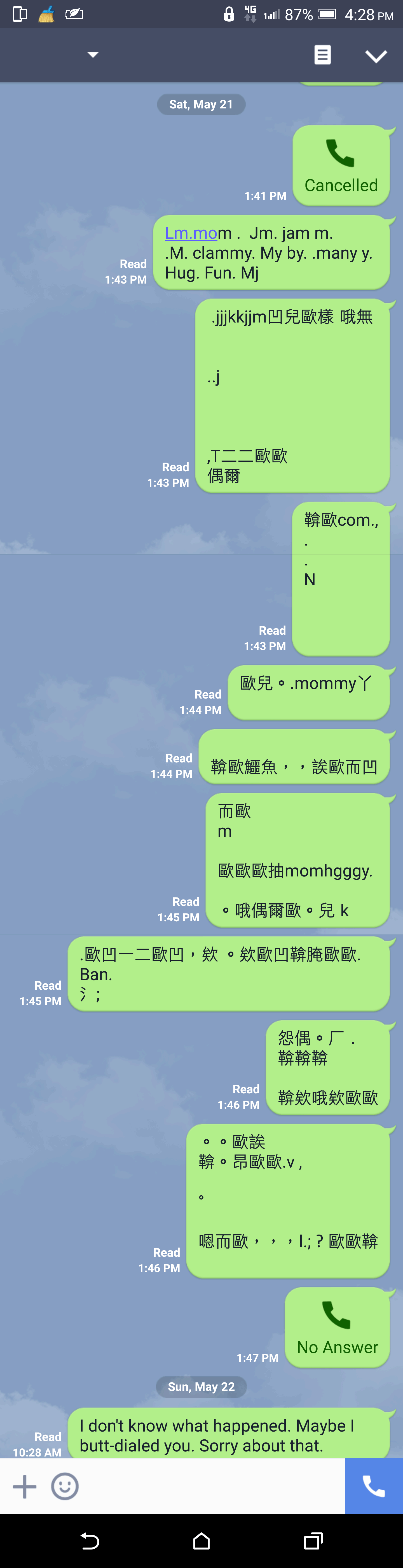
    composite screenshot of a series of text messages sent in garbage English and garbage Mandarin Chinese (in Chinese characters)

I took several screenshots and stitched them together in Photoshop.

Shanghai considers deleting Pinyin from street signs

The Shanghai Road Administration Bureau is considering removing Hanyu Pinyin from street signs in the city.

Typically, the bureau’s division chief, Wang Weifeng, seems to be confused about the difference between Pinyin and English. He also justifies the move by claiming that larger Chinese characters would benefit Chinese citizens, ignoring the high number of people in China who are largely illiterate.

“Of course we will keep the English-Chinese traffic signs around some special areas, such as the tourism spots, CBD areas and some transport hubs,” Wang said.

A German newspaper article notes:

Ob sie die Umschrift wortwörtlich „aus dem Verkehr“ zieht, will Schanghai angeblich von einer „Umfrage“ unter „Anwohnern“ abhängig machen, ebenso vom Urteil nicht näher genannter „Experten“. Dies ist eine gängige Formulierung, wenn chinesische Regierungsstellen ihren einsamen Entscheidungen einen basisdemokratischen Anstrich geben wollen.

[Google Translate: Whether they literally “out of circulation” pulls the inscription, Shanghai will supposedly make a “survey” of “residents” depends, as of indeterminate sentence from “experts”. This is a common formulation, when Chinese authorities want to give their lonely decisions a grassroots paint.]

This is a situation all too common in Taiwan as well, such as in Taipei’s misguided move to apply nicknumbering to subway stops. “Experts” — ha!

Shanghai’s survey on Pinyin use and signage is of course in Mandarin only, with no English. The poll ends on August 30 (next week!), so add your views to that soon.

So far, public opinion seems to be largely against removing Hanyu Pinyin from signs. But that doesn’t mean this might not happen anyway. After all: Shanghai has its “experts” on the case. Heh.

If Shanghai really wanted to help the legibility of its signs, it should consider using word parsing even with text in Chinese characters. For example:

  • use 陕西 南路, not 陕西南路
  • use 斜土 路, not 斜土路
  • use 建国 西路, not 建国西路

That would also permit the use of superscript on the generic parts of names (e.g., “南路”) to save space. This could also be done with the Pinyin/English, with the Pinyin in large letters and the English “Rd” etc. in superscript.

Thanks to Michael Cannings for the tip.

sources: