
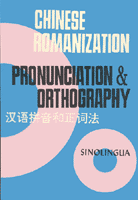
 Today’s selection from the rules on how to write Pinyin deals with measure words (800 KB PDF).
Measure words are a pet peeve of many beginning Mandarin students. (“But teacher, why can’t we just use ge for everything?”) Many more advanced students, however, get a sort of perverse pleasure out of memorizing them. If you fall into the latter group, be sure to go through the PDF linked to above, as it supplies more than 100 measure words, along with sample usages.
Fortunately, although measure words themselves can be a real pain for non-native speakers to memorize, the rules for writing them are simple: in almost all cases they’re separate.
- yī bēi chá (a cup of tea)
- yī běn shū (a book)
- yī jiān fángzi (a house)
- yī kuài qián (one yuan / one NT dollar)
- yī liàng zìxíngchē (a bicycle)
- yī piàn miànbāo (a slice of bread)
- yī píng jiǔ (a bottle of wine)
- yī tóu shuǐniú (a water buffalo)
- yī zhāng zhǐ (a sheet of paper)
- yī zhī gānbǐ (a fountain pen)
I have some friends who are good at Pinyin who say that yi ge (but not liang ge, san ge, etc.) is an exception, that it should be written solid: yige. But I have yet to see this stated in the rules; and from what I’ve seen Yin Binyong writes them separate just like everything else. Of course, it’s possible I’ve overlooked something.
Slightly trickier are indefinite measure words.
There are only two indefinite measure words in Putonghua: xiē 些 (some; a few) and diǎnr 点儿 [or just plain ol’ diǎn 点] (a little, a bit).
xiē 些 indicates a fairly large number or amount. It can follow the numeral yī 一 (one), a demonstrative pronoun zhè 這 (this) or nà 那 (that), or certain other modifiers. It is written as one unit with the component it follows:
- yīxiē 一些 (some);
- zhèxiē 這些 (these);
- nàxiē 那些 (those);
- hǎoxiē 好些 (a lot of).
diǎnr 点儿 indicates a small number or amount. It can follow the numeral yī 一 (one), a demonstrative pronoun zhè 這 (this) or nà 那 (that), or certain other modifiers. It is written as one unit with the component it follows:
- yīdiǎnr 一點兒 (a bit, a little);
- zhèdiǎnr 這點兒 (this bit, these few);
- nàdiǎnr 那點兒 (that bit, those few).
When xiē or diǎnr are preceded by a verb, however, they are written separately from it:
- chī xiē dōngxi 吃些東西 (eat something);
- xiě xiē wénzhāng 寫些文章 (do some writing);
- chī diǎnr dōngxi 吃點兒東西 (eat a little something);
- xiě diǎnr wénzhāng 寫點兒文章 (do a little writing).
Pingback: How to write numbers and measure words in Hanyu Pinyin | Pinyin News