
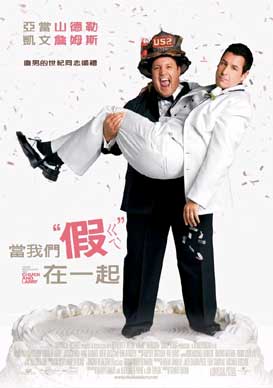
 A movie currently doing well at the box office in both the United States and Taiwan is I Now Pronounce You Chuck and Larry. In Taiwan, the film has been given the linguistically interesting title Dāng wǒmen gèi zài yīqǐ (《當我們ㄍㄟˋ在一起》 / 《當我們假在一起》 ).
The title is a Mandarin phrase that uses Taiwanese in order to make a pun involving English — an apt mix for the island.
The movie title is an allusion a well-known children’s song, “Dāng wǒmen tóng zài yīqǐ” (當我們同在一起), which was taken from the English-language children’s song “The More We Are Together.”
The more we get together,
Together, together,
The more we get together,
The happier we’ll be;
For your friends are my friends
And my friends are your friends,
The more we get together,
The happier we’ll be.
This song uses the tune of Ach du lieber Augustin but has radically different words.
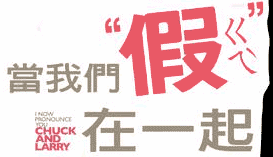 Getting back to the Taiwanese title, “tóng” (同) of “Dāng wǒmen tóng zài yīqǐ” has been replaced by what in Mandarin is jiǎ (假 — false, fake). But the character 假 has been assigned a Taiwanese reading, gèi, as can be seen by the inclusion of zhuyin fuhao to the right of the character (ㄍㄟˋ = gèi in Hanyu Pinyin).
Gèi is of course meant to call to mind not just the “false” of the relationship in the movie but also the English word “gay” — this being a movie about two men pretending to be a homosexual couple.
In China, where foreign movies often receive titles different from those in Taiwan, the movie is called Wǒ shèngdà de tóngzhì hūnlǐ (《我盛大的同志婚礼》/ My Magnificent Comrade’s Wedding). Although the usual translation for tongzhi is “comrade,” the word has also become Mandarin slang for homosexual. Perhaps some readers can comment on how prominent or passé this use of tongzhi is now.
Pingback: David on Formosa » Links 6 August 2007
I noticed this clever title a while back and was going to blog about it, but you beat me to it. Unfortunately, the movie itself was disappointing. And I went in with pretty low expectations to begin with.
As an aside Taiwanese, like Mandarin, has two readings for the ? character. In Mandarin you have “ji?” (false) and “jià” (holiday, vacation). In Taiwanese, the distinct meanings are preserved, this time with “ge?i” (written as ke? in POJ romanisation) for “false” and “gà” (POJ: ka?/kà) for “vacation”.
This could be a stretch, but in Taiwanese, “gei” also shares the same pronunciation with ? (“to marry”). I’m wondering if we’re dealing with a third play on words, here, too.
I was going to suggest the same as Nick- for a second I thought you mistyped the character “jia” and instead intended to write the character for marry.
In Taiwanese, the distinct meanings are preserved, this time with “ge?i” (written as ke? in POJ romanisation) for “false” and “gà” (POJ: ka?/kà) for “vacation”.
======================================================
This could be a stretch, but in Taiwanese, “gei” also shares the same pronunciation with ? (”to marry”). I’m wondering if we’re dealing with a third play on words, here, too.
=======================================================
It’s a stretch. The Taiwanese words for “false” (‘kea’ in MLT) and “to marry” (‘kex’ in MLT) have different tones. “false” takes a high-falling tone, while “to marry” takes a low tone.