Hanyu Pinyin and proper nouns

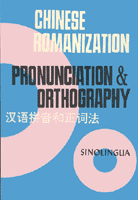
cover of Chinese Romanization: Pronunciation and OrthographyThe first large section from Chinese Romanization: Pronunciation and Orthography to go online is the one on proper nouns (2 MB PDF).

  1. Introduction
  2. Place Names
  3. Personal Names
    1. formal names
    2. non-formal names
    3. forms of address
  4. Transliteration of Foreign Place Names and Personal Names
  5. Other Proper Nouns
    1. names of nationalities
    2. names of religions and deities
    3. names of dynasties
    4. names of festivals and holidays
    5. names of celestial bodies
    6. names of languages
    7. titles of literary and artistic works
    8. titles of newspapers and magazines
    9. names of social units
    10. trademarks
  6. Proper Nouns in Combination with Common Nouns

Thus, these rules cover many of the applications of Pinyin that appear on signage.

I’ll post a version with OCR later (probably weeks or months rather than days). In the meanwhile, you can use the bookmarks within the PDF file to navigate the document.

further reading:

detailed rules for Hanyu Pinyin: a major addition to Pinyin.Info

cover of Chinese Romanization: Pronunciation and OrthographyFor several years I’ve had online the brief official principles for writing Hanyu Pinyin. But those go only so far. Fortunately, Yin Binyong (Yǐn Bīnyōng / 尹斌庸) (1930-2003), who was involved in work on Hanyu Pinyin from the beginning, wrote two books on the subject, producing a detailed, logical, and effective orthography for Pinyin.

The only one of those two books with English explanations as well as Mandarin, Chinese Romanization: Pronunciation and Orthography (Mandarin title: Hànyǔ Pīnyīn hé Zhèngcífǎ / 汉语拼音和正词法 / 漢語拼音和正詞法), has gone out of print; and at present there are no plans to bring it back into print. Fortunately, however, I was eventually able to secure the rights to reproduce this work on Pinyin.Info. Yes, the entire book. So everybody be sure to say thank you to the generous publisher by buying Sinolingua’s books.

This book, which is nearly 600 pages long, is a mother lode of information. It would be difficult for me to overstate its importance. Over the next few months I’ll be releasing the work in sections. I had intended to delay this a little, as I have had to wait for a fancy new scanner and am still awaiting some OCR software that can handle Hanzi as well as the Roman alphabet. (This Web site is an expensive hobby!) But since Taiwan has recently adopted Hanyu Pinyin I will be releasing some material soon (without OCR, for the time being) in the hope of helping Taiwan avoid making mistakes in its implementation of an orthography for Pinyin here.

Watch this blog for updates.

The Art of War: a companion volume

Sonshi, the largest website dedicated to Sun Zi’s (Sun Tzu’s) Art of War, recently selected Victor H. Mair’s new translation as “the #1 Art of War edition.”

In announcing its judgment, the site stated, “how rare a book that courageously stands up to centuries of established thought, proceeds to knock it down with sound logic and proof, and succeeds in convincing even the Old Guard to change their views.”

Professor Mair has just published a free, book-length companion to his translation: Soldierly Methods: Vade Mecum for an Iconoclastic Translation of Sun Zi bingfa, with a complete transcription and word-for-word glosses of the Manchu translation by H. T. Toh (1 MB PDF).

Yes, all that and Manchu too. The appendixes might well supply the longest text in romanized Manchu available online — not to mention the longest one with English translation. (Perhaps someone from Echoes of Manchu can comment.)

And I’d like to note the introduction to the transcription offers a cool word I hadn’t come across before: Mandjurist, which is German for “Manchu philologist.”

Here’s the table of contents:

  • Preface
  • Principles of Translation
  • Guide to Pronunciation
  • Key Terms
  • Abbreviations
  • Discussion
    • The Book and Its Title
    • Authorship
    • Historical Background
    • Dating
    • Stylistics and Statistics
    • Techniques and Technology
    • Taoistic Aspects
    • Eurasian Parallels
    • On the World Stage
    • Notes
  • Appendix I: The Pseudo-Biography of Sun Wu
  • Appendix II: Further Notes on Selected Key Terms
  • Appendix III: Transcription of the Manchu Translation of the Sun Zi with Word-for-Word English Glosses by Hoong Teik Toh
  • Appendix IV: Transcription of the Manchu Translation of the Sun Zi by Hoong Teik Toh
  • Bibliography

This is issue no. 178 of Sino-Platonic Papers.

John DeFrancis video

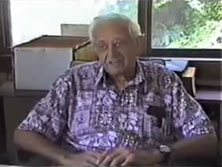
John DeFrancisTen years ago John DeFrancis was awarded the Chinese Language Teachers Association’s first lifetime achievement award. Since he could not be present at the association’s annual conference to receive the award, he sent a videotape of a 12-minute acceptance speech. The video was recently edited down to 6:27 and uploaded to YouTube: John DeFrancis remarks.

Here’s my summary of the main points:

0:00 — While working on what he intended to be a largely political study of Chinese nationalism, DeFrancis encountered references to people who wanted China to adopt an alphabetic writing system, an idea which he initially dismissed. But discovering Lu Xun’s interest in romanization led him to investigate the matter further. [I’m frustrated by the cut away from this discussion. Perhaps a fuller version of the video will be posted later.]
1:30 — Emphasizes he’s not in favor of completely abandoning Chinese characters. Rather, he favors digraphia.
2:30 — “I’d like to mention three aspects of the Chinese field which have interested me.”

  1. pedagogy (2:50) — lots of advancements
  2. linguistic aspect (3:20) — that’s also progressing well
  3. socio-linguistics (3:52) — the field isn’t doing as well as it should be

5:00 — computers and Chinese characters. DeFrancis tears into the Chinese government for its emphasis on shape-based character-input methods rather than Pinyin.

Ma administration still undecided on how to teach Taiwanese

Under the new administration of President Ma Ying-jeou, Taiwan’s Ministry of Education has worked out its plan for teaching pretty much everything … except for Hoklo (the language better known in these parts as “Taiwanese”). There have been a lot of arguments. How early to start teaching the language? How much should be taught? Use romanization? Use zhuyin? May teachers use any kind of soap or only special kinds when washing out the mouths of students speaking the language? (OK, they don’t do that last one anymore.)

So the ministry has decided to appoint a new committee to review such questions. Decisions on these issues are expected in six months or so.

My guess would be that the ministry is going to pack the new committee with conservatives who will see to it that romanization is avoided or at least belittled, that little of the language will actually be taught, and that students will not be tested seriously on the subject. But I’ll be happy if I’m wrong.

sources:

Park Street redux

As some of you may recall, last October I wrote about finding official signs for a Taipei street that used English rather than romanization (Street names in English translation: trend or error?).

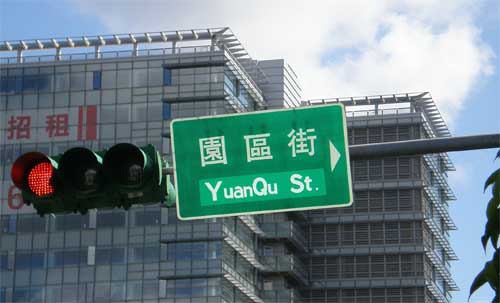
Some of the signs for what is written in Hanzi “園區街” (Yuánqū Jiē) read, in Taipei’s standard but stupid InTerCaPiTaLiZaTion, “YuanQu St.” while others read “Park St.” (which, by the way, is a misleading translation). I called the Taipei City Government about this and was informed that Park was an error and that the signs would be fixed to read Yuanqu.

Nearly a year has gone by since then. Have any of the street signs been changed?

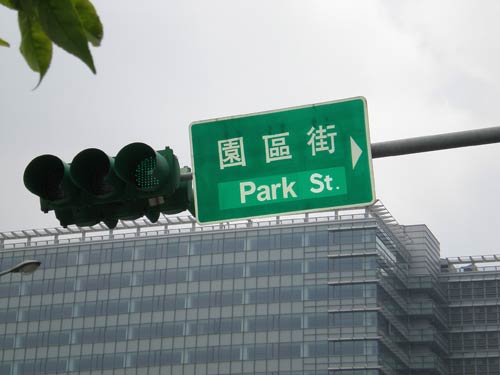
The answer is yes. The signs, including some new ones, are indeed consistent. All of them now read — have you guessed it yet? — “Park St.”

That’s right: They eliminated the signs that were correct and put up new signs that are wrong. I’m trying to relax, so I won’t write out all of the many maledictions I have been muttering about Taipei City Government and its bureaucracy.

Here’s one of the street signs in October 2007:
YuanQu St.

Here’s the same sign in August 2008:
Park St.

A close-up, showing how “Park” was pasted over “YuanQu”.
closeup of the sign, showing how 'Park' was pasted over 'YuanQu'

software for Shanghainese

Professor Qián Nǎiróng (Qian Nairong / 錢乃榮) of Shanghai University has just issued free software to help with the writing of Shanghainese (上海话). People may now download the 1.3 MB zip file of the program.

Some examples:

shanghe 上海
shanghehhehho 上海闲/言话(上海话)
whangpugang 黄浦江
suzouhhu苏州河
shyti 事体(事情)
makshy 物事(东西)
bhakxiang 白相(玩)
dangbhang 打朋(开玩笑)
ghakbhangyhou 轧朋友(交朋友)
cakyhangxiang 出洋相(闹笑话,出丑)
linfhakqin 拎勿清(不能领会)
dhaojiangwhu 淘浆糊(混)
aoshaoxhin 拗造型(有意塑造姿态形象)
ghe 隑(靠)
kang 囥(藏)
yin 瀴(凉、冷)
dia 嗲
whakji 滑稽

The program offers two flavors of romanization. Here are some examples of the differences between the two styles:

New Folk Old Timers
makshy 物事(东西)
bhakxiang 白相(玩)
dangbhang 打朋(开玩笑)
ghakbhangyhou 轧朋友(交朋友)
cakyhangxiang 出洋相(闹笑话,出丑)
linfhakqin 拎勿清(不能领会)
mekshy 物事(东西)
bhekxian 白相(玩)
danbhan 打朋(开玩笑)
ghakbhanyhou 轧朋友(交朋友)
cekyhanxian 出洋相(闹笑话,出丑)
linfhekqin 拎勿清(不能领会)

Here’s a brief story on this:

Xiànzài, wǒmen zài wǎngluò zhōng liáotiān de shíhou yuèláiyuè duō de péngyou dōu kāishǐ xǐhuan yòng Shànghǎihuà. Dànshì yǒushíhou shìbushì juéde xiǎng biǎodá dehuà bùzhīdào zěnme dǎ, nòng de yǒudiǎn bùlúnbùlèi ne? Xiànzài, yī ge kěyǐ qīngsōng dǎchū Shànghǎihuà de chéngxù chūlai le.

Jīngguò liǎng nián nǔlì, Shànghǎi dàxué Zhōngwénxì Qián Nǎiróng jiàoshòu jí tā de yánjiūshēng hé dādàng zhōngyú yú běnyuè wánchéng le Shànghǎihuà shūrùfǎ de zhìzuò. Zhíde guānzhù de shì, zhè tào shūrùfǎ hái bāokuò xīn-lǎo liǎng ge bǎnběn, 45 suì yǐshàng de lǎo Shànghǎi rénhé niánqīng yī dài de Shànghǎirén dōu kěyǐ zhǎodào zìjǐ de “dǎfǎ.”

Háishi tóngyàng 26 ge zìmǔ de jiànpán, 8 yuè 1 rì qǐ xiàzài le Shànghǎihuà shūrùfǎ zhīhòu, nín jiù kěyǐ tōngguò shūrù “linfhakqin” dǎchū “līn wù qīng,” shūrù “dhaojiangwhu” dǎchū “táo jiànghu” děng yuánzhī yuán wèi de Shànghǎihuà le. Zuótiān, jìzhě tíqián xiàzài dào gāi ruǎnjiàn. Ànzhào shǐyòng shuōmíng, yòng quánpīn de fāngshì chángshì shūrù “laoselaosy” zhèxiē zìmǔ, píngmù shàng, lìjí chūxiàn le “lǎo sānlǎo sì” (Shànghǎihuà, yìsi shì “màilǎo, chōng lǎochéng de yàngzi”).

Jùxī, yóuyú Shànghǎihuà yǔ Pǔtōnghuà de dúfǎ yǒusuǒbùtóng, suǒyǐ zài pīnyīn pīnxiě fāngshì shàng háishi xūyào shǐyòng shuōmíng de bāngzhù. Bǐrú jìzhě fāxiàn, fánshì yǔ Pǔtōnghuà shēngmǔ, yùnmǔ xiāngtóng de zì, zài Shànghǎihuà shūrùfǎ zhōng zuìzhōng yòng de háishi Pǔtōnghuà pīnyīn, bùtóng de zé cǎiyòng Shànghǎihuà shūrùfǎ de pīnxiě fāngshì. Rú “chénguāng” de “chén,” “huātou” de “tóu” dōu fāchéng zhuóyīn, Shànghǎihuà pīnyīn shūrùfǎ zhōng yàozài shēngmǔ zhōng jiā yī ge zìmǔ h, pīnchéng “shen,” “dhou;” fánshì rùshēng zì, zé zài pīnyīn hòu jiā zìmǔk, rú “báixiāng” de “bái” jiù pīnchéng bhek.

Bùguò, dàjiā bùyào juéde tài nán. Jìzhě fāxiàn, Shànghǎihuà shūrùfǎ yǔ Pǔtōnghuà de shūrùfǎ zuìdà xiāngtóng zhī chǔzài yú, zhǐyào liánxù shūrù shēngmǔ hé yùnmǔ jiù kěyǐ, bùxū shūrù shēngdiào. Cǐwài, Shànghǎihuà pīnyīn shūrù xìtǒng háiyǒu lèisì “zhìnéng” yōudiǎn, kěyòng suōlüè fāngshì bǎ cíyǔ pīnxiě chūlai.

Zhǔchí Shànghǎihuà shūrùfǎ kāifā de Shànghǎi dàxué Zhōngwénxì Qián Nǎiróng jiàoshòu gàosu jìzhě, zhè tào shūrùfǎ bùjǐn néng dǎchū Shànghǎihuà dà cídiǎn zhōng 15,000 duō ge cítiáo, érqiě hái néng yòng Shànghǎihuà pīnyīn dǎchū Shànghǎihuà zhōng shǐyòng zhe de, yǔ Pǔtōnghuà cíyì xiāngtóng dàn yǔyīn bùtóng de chángyòng cíyǔ. Rú “Huángpǔ Jiāng” shūrù “whangpugang” , “lǐxiǎng” zéshì lixiang děng, gòngjì 10,000 duō ge cítiáo.

sources:

Ovid Tzeng reiterates backing for Hanyu Pinyin

Earlier this week Ovid Tzeng, a former minister of education and current minister without portfolio, reaffirmed his support for Taiwan adoping Hanyu Pinyin and said that this is an important issue the government will need to deal with sooner or later.

Zēng Zhìlǎng Jiàoyùbù zhǎng rènnèi, jiānchí cǎiyòng Hànyǔ Pīnyīn, shì tā bèi huàn xiàlái de zhǔyīn zhīyī. Tā zuótiān réng bù gǎi qí zhì, qiángdiào guówài bùguǎn Zhōngwén jiàoxué huò xuéshù qīkān, hěn duō yǐjing gǎiyòng Hànyǔ Pīnyīn, Táiwān bùnéng shìruòwúdǔ, zhè suī fēi xīn zhèngfǔ zuì yōuxiān shīzhèng xiàngmù, dànshì yě lièwéi wèilái zhòngdà jiǎntǎo shìxiàng.

Most of the source article for this discusses poet and academic Zheng Chouyu’s backing for Hanyu Pinyin. He stresses his view that this is a practical matter, not a political one.

source: Zhèng Chóuyǔ jiànyì: Zhōngwén yìyīn kěyǐ cǎi Hànyǔ Pīnyīn (鄭愁予建議:中文譯音 可採漢語拼音), United Daily News, June 9, 2009

further reading: Hanyu Pinyin backer to return to Taiwan’s Cabinet, Pinyin News, April 29, 2008