San Francisco Chinatown signage

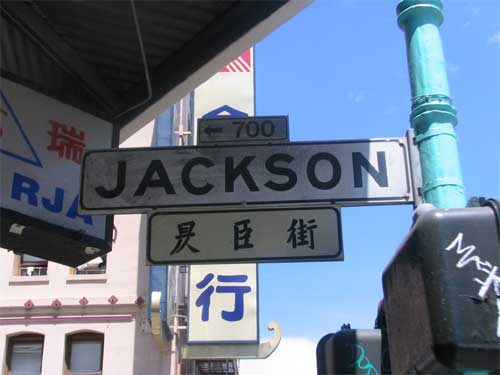
Here are some photos I took a couple of years ago in San Francisco’s Chinatown.

As should be clear from the Mandarin and Cantonese pronunciations I’ve provided for the Chinese characters, the Sinitic names for streets in Chinatown certainly don’t come from Mandarin, which isn’t surprising given how the Chinese diaspora was not predominantly Mandarin speaking until recently. My guess would be Taishanese Cantonese.

Beckett: 白話轉街 (Mandarin: Báihuàzhuǎn Jiē; Cantonese: baahk- wa/ jyun/ )
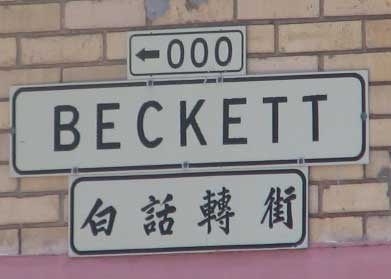
BECKETT 白話轉街

I like this unofficial sign even better.
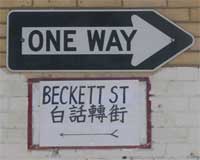
a one-way sign, beneath which is a hand-lettered sign reading BECKETT ST 白話轉街

Jackson: 昃臣街 (Mandarin: Zèchén Jiē; Cantonese: jak\ sahn\)

The first Chinese character, 昃, is a surprising choice since it is quite rare and would not be known by most people. Some far more common characters that perhaps could have been used instead include 則 (Cantonese: jak\), 責 (Cantonese: jaak-), 澤 (Cantonese: jaahk-), and 擇 (Cantonese: jaahk-) — all of which are pronounced in Mandarin.

Jackson 昃臣街

Clay: 企李街 (Mandarin: Qǐlǐ Jiē; Cantonese: keih/ leih/)
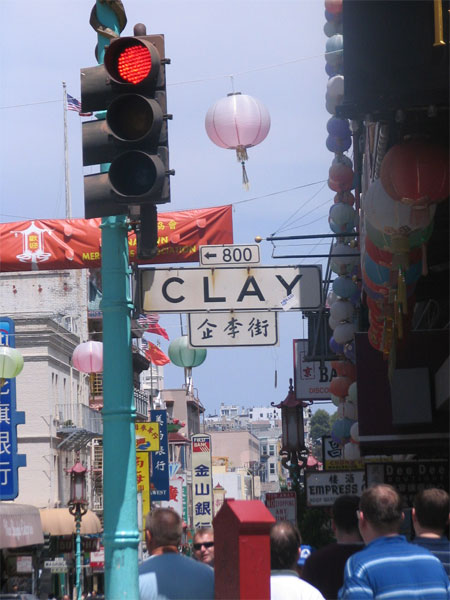
streetsign for Clay Street, with 企李街 in Chinese characters

Commercial: 襟美慎街 (Mandarin: Jīnměishèn Jiē; Cantonese: kam\ meih/ sahn-)

I would have expected a semantic translation for this street name. But Kam-meih-sahn appears to be another phonetic approximation.

'Commercial 襟美慎街' -- a bronze placque embedded in brick paving

Grant: 都板街 (Mandarin: Dōubǎn Jiē; Cantonese: dou\ baan/ gaai\)

This is another interesting one. Note that Doubaan and Grant sound nothing like each other. And this isn’t a semantic translation of Grant either. So why is this street labelled 都板街? The answer is that the Sinitic name preserves an old name of the street: Dupont.

street sign reading 'Grant 都板街'

And for lagniappe, here’s a photo taken in the nearby Italian district, where Columbus Street is also identified in Italian as Corso Cristòforo Colombo.
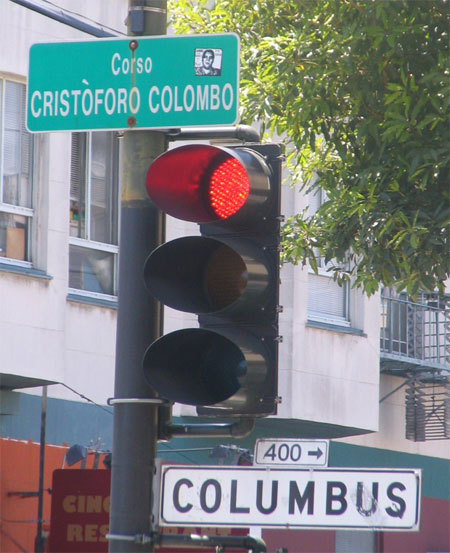
as described above

further reading:

writing four-syllable idioms in Pinyin

cover of Chinese Romanization: Pronunciation and OrthographyThe latest excerpt from Yin Binyong’s book on Pinyin orthography covers how to write four-syllable idioms in Hanyu Pinyin (929 KB PDF). Here’s a key passage:
almost all four-character idioms can be broken in two halves, called yǔjié 语节 (language segments), on the basis of phonetic structure. The simple expedient of connecting the two yǔjié with a hyphen then provides idioms with their own distinctive written form, and assures ease of writing and reading. It is also a simple rule for students of HP to master.

But not all four-syllable idioms follow this rule, as the reading shows.

This is a worthwhile reading for Mandarin learners, even if you’re not particularly interested in Pinyin. There are many examples of idioms here, all given in Hanzi, Pinyin, and English.

Lugang signs

My wife and I also recently traveled to Lugang (Lùgǎng / 鹿港 / often spelled “Lukang”). This is in Zhanghua (Changhua) County, not far from Taizhong. It makes a nice day trip from Taipei, especially if using the high-speed rail for transportation.

Despite this being the second photo-laden post in a row, I haven’t dropped my general love of low-bandwidth entries. These photos are in part evidence toward an important point that I think is getting overlooked in the discussions of how much it will cost Taiwan to change to Hanyu Pinyin: The signs in much of Taiwan remain inconsistent and something of a mess despite the at-best partially instituted change several years ago to Tongyong Pinyin. More on that in a later post.

Now for the signs.

Lugang, whose name means “deer harbor,” put deer signs atop some signposts.

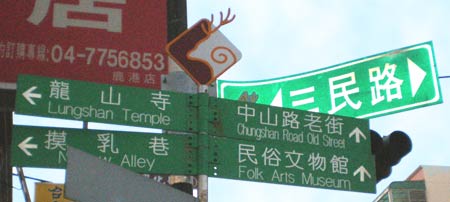
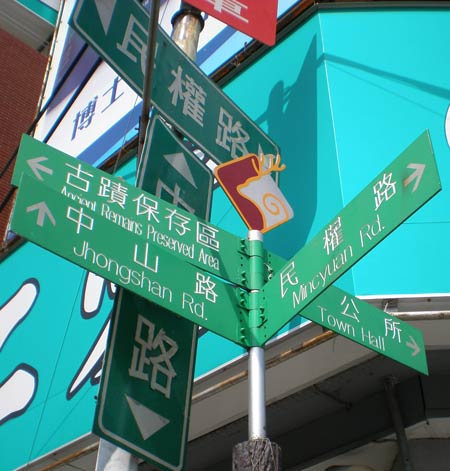
Many of the signs in Lugang are in Tongyong Pinyin (e.g., Jhongshan and Mincyuan, for what in Hanyu Pinyin would be Zhongshan and Minquan). Note that other signs are in English — or in Chinese characters with no romanization at all. (Note, too, that the two signs for Minquan Road (民權路) — one of which is partially covered — point in different directions!)

But Tongyong Pinyin certainly isn’t the only romanization system found there. Here, for example, we have Wade-Giles (“Longshan,” “Zhongshan”). (Note that there’s no romanization given for Sānmín Road / 三民路.)
Lungshan Temple, Jhongshan Road Old Street, 三民路, Folk Arts Museum

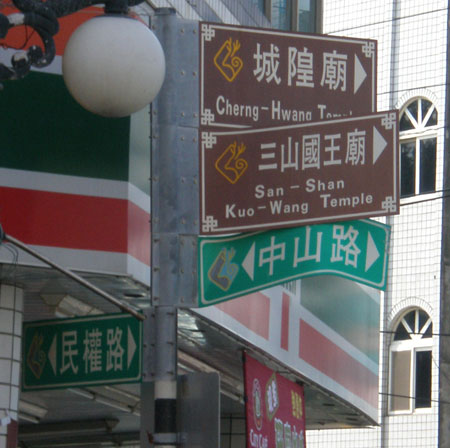
And here’s yet another romanization system on official signage within Lugang. In the photo below the top sign is in the rarely seen Gwoyeu Romatzyh: Cherng-Hwang Temple, which in Hanyu Pinyin is Chénghuáng (“city god”) Miào (城隍廟). The sign below that (“San-Shan Kuo-Wang”) is in Wade-Giles. And the two signs below that don’t have any romanization at all. None of these signs are likely very old.

About 150 years ago “bilingual” signage meant something very different in Taiwan than it does today. Back then it was Literary Sinitic and Manchu, as seen on this stela outside a temple in Lugang.
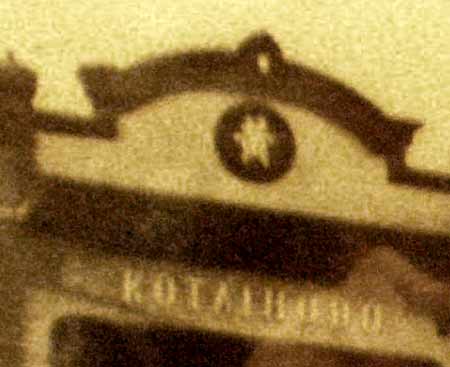
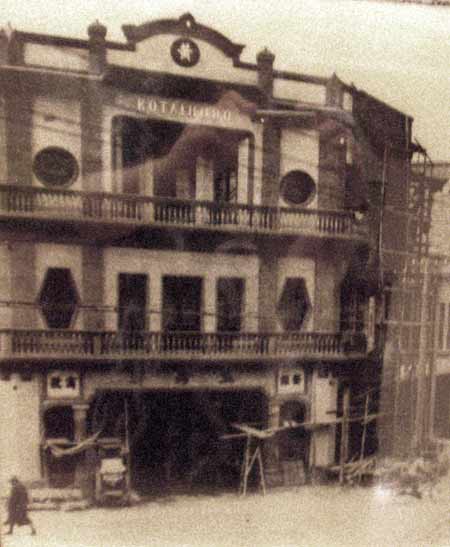
While in the Lugang Folk Arts Museum I spotted a photo from the Japanese era of a building with romanization. Note, too, the “Huang” (黃) at the top, which marks the ownership of the Huang family. Many buildings in Lugang bear that mark.

Here’s the whole building:

I didn’t notice that particular building while I was walking around the town. But I did see this one, with “CHIN” in large letters:

No less interesting are the letters, now largely effaced, near the top of the same building (click to enlarge). They were used to write something in Taiwanese.
taioan

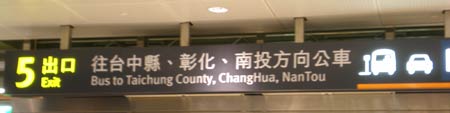
After leaving Lugang, what should I see at the Taizhong high-speed rail station but InTerCaPiTaLiZation. That practice is a cancer on romanization everywhere.
exit sign at the Wuri (Taizhong) high-speed rail station, reading 'Bus to Taichung County, ChangHua, NanTou'

I feel a little guilty because much of Lugang — at least its historic section — is lovely and worth visiting. But here I’ve been showing you a bunch of signs. If you’d like to see what Lugang looks like beyond its signs, try parts one, two, and three of Craig Ferguson’s posts on his visit there.

Penghu street signs

My wife and I recently spent a weekend in Penghu, a beautiful, stark archipelago between the main island of Taiwan and China.

Since Penghu is under KMT rule, I expected to find street signs in Magong, the capital, in some old system (e.g., MPS2 or perhaps bastardized Wade-Giles) or perhaps even Hanyu Pinyin. (Highway signs, however, are a different matter. They’re put up by the central government, which means that relatively recent ones are in Tongyong Pinyin, regardless of which party might control the area.)

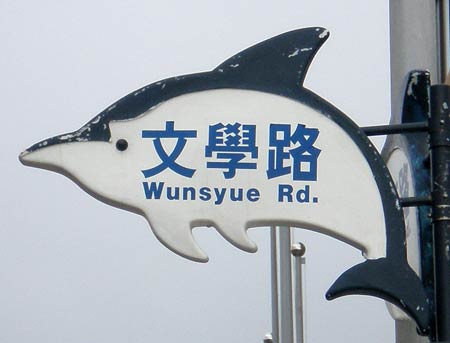
This first street sign, however, is unmistakably in Tongyong Pinyin, giving “Wunsyue” (for what in Hanyu Pinyin would be “Wenxue”).
street sign reading 'Wunsyue Rd.' (Wenxue Road)

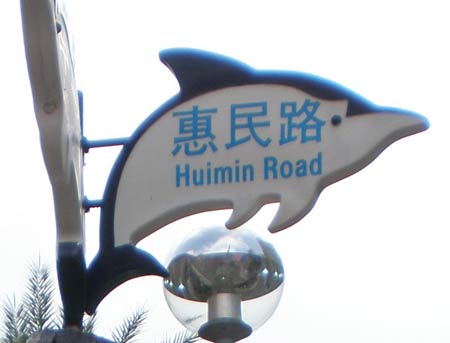
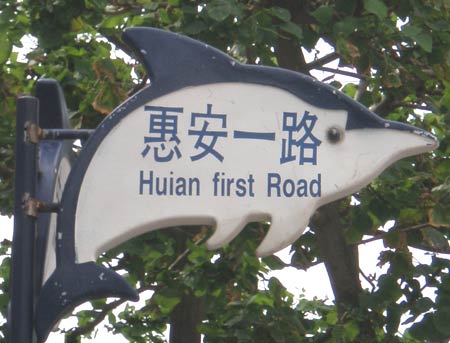
But I looked around some more and saw signs in Hanyu Pinyin, such as “Huimin” for what in Tongyong would be “Hueimin” and “Hui[‘]an” for what in Tongyong would be “Huei[-]an.”
street sign reading 'Huimin Road'

street sign reading 'Huian first Road'

So were there some signs in Hanyu Pinyin after all? Apparently only coincidentally. The previous two hui signs were probably just a mistake, the result of Taiwan’s standard, sloppy chabuduo jiu keyi approach to signage. Here’s a sign on the same street as above; but in this case “惠” is romanized huei and not hui. (And “first” is missing, from both the Hanzi and romanization.)
street sign reading 'Hueian Rd.'

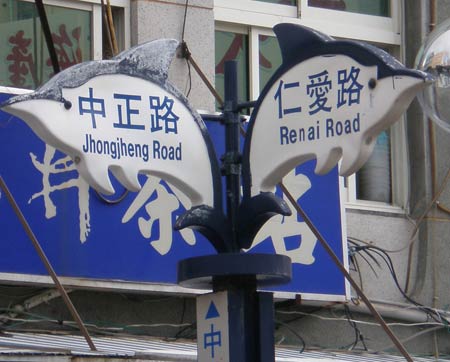
Most signs were in Tongyong, such as these. (Note that Penghu, too, has a Hot Milk Road.)
street signs: 'Jhongjheng Road' (Zhongzheng Road) and 'Renai Road' (Ren'ai Road)

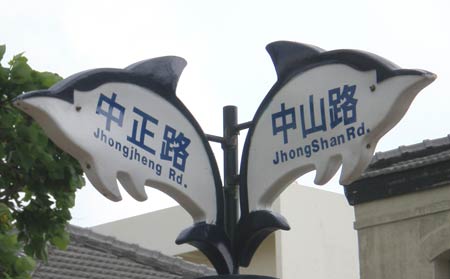
So, Tongyong after all. Well, at least they don’t have InTerCaPiTaLiZaTion … or do they?
street signs reading 'JhongShan Rd.' -- note InTerCaPiTaLiZaTion -- (Zhongshan Road) and 'Jhongjheng Rd.' (Zhongzheng Road) -- no intercapping

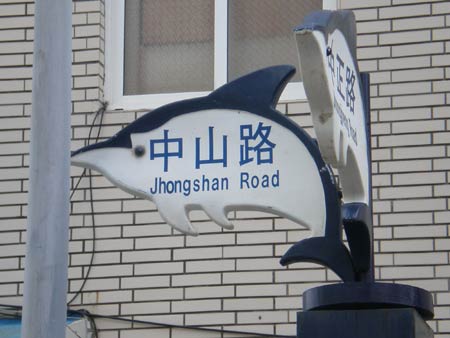
Fortunately, that sign was a one-off. I didn’t spot InTerCaPiTaLiZaTion elsewhere. Here’s another sign from the same road:
street sign reading 'Jhongshan Rd.' (Zhongshan Road)

So, in short, Penghu’s street signs are in Tongyong Pinyin — but with plenty of mistakes and inconsistencies (e.g., missing apostrophes/hyphens, “first” rather than “1st”, and both “Road” and “Rd.”). It’s especially ridiculous that the KMT-administered Penghu bothered with Tongyong, especially since it was free to adopt Hanyu Pinyin. Now it’s going to have to change its signs over to Hanyu Pinyin. But some of the signs would need to be updated anyway, since many already show signs of age, with letters missing. (My guess is that Penghu put up such low-quality signs that in the annual windy season some of the letters just get blown away.)

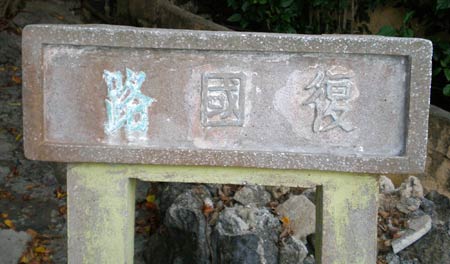
Here’s a sign in little danger of having its writing blow away any time soon. This is what a much older Magong street sign looks like. Note that it must be read from right to left: 復國路 (Fuguo Road — “Recover Atlantis the Lost Country Road”).
old concrete street sign reading, right to left, '復國路' (Fuguo Road)

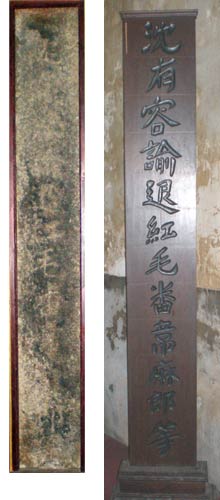
Finally, here’s something that isn’t a street sign at all. But it is nonetheless a sign of historic importance, since it’s a stela that commemorates the Ming Chinese official Shen Yourong telling the red-haired barbarians (i.e., Westerners — in this case, the Dutch) to get the hell out of Penghu. (The Dutch were told they could instead go to Taiwan, since back then China didn’t care about it in the least.) The composite photo shows both the 400-year-old stone original and a modern reproduction in wood.

photos of the original stone stela and a modern reproduction in wood

The text reads “Shěn Yǒuróng yù tuì hóngmáo fān[zi] Wéimálàng děng” (「沈有容諭退紅毛番韋麻郎等」): “Shen Yourong orders the red-haired foreigners under [Dutch commander] Wybrand van Warwijck to withdraw.”

all 325 ‘words that form the Chinese language’

The New York Public Library’s Digital Gallery offers a glimpse inside a book published in the 1770s: The Chinese traveller. Containing a geographical, commercial, and political history of China..

The book provides a chart of 325 syllables identified as being “A LIST of all the WORDS that form the CHINESE LANGUAGE.” I’ll skip the obvious and not address why that’s ridiculous.

The chart is apparently in the first volume of the work. But since the NYPL doesn’t provide many images and Google Books provides only the second volume (scanned from the one in the NYPL collection), I wasn’t able to find any explanatory text about the chart or the authors’ views of Sinitic languages.

Here’s one column:

mouen, moui, moum, mouon, na, nai, nam, nan, nao, nem, ngai, ngan, ngao, ngue, nguen, ngeo, ngo, ni, niam, niau, niao, nie, nien, nieou, nio

Which Sinitic language these are supposed to represent isn’t clear. But, no, it doesn’t appear to be Cantonese, which tends to be the default first guess when it comes to Sinitic languages — at least until recently. My guess is that it’s some form of Mandarin that’s been written in a bastardized way, obscuring differences between what are represented in Pinyin by b and p, d and t, g and k, etc. But then there are those -m finals. What do the rest of y’all think?

sources:

gov’t unveils online Taiwanese dictionary

Taiwan’s Ministry of Education has put online its new Taiwanese (Hoklo) dictionary, the Táiwān Mǐnnányǔ chángyòngcí cídiǎn (giving the Mandarin name) (臺灣閩南語常用詞辭典). The preliminary version, which is to be amended in six months, contains 16,000 entries.

I especially welcome the section on Taiwan place-names.

further reading: MOE launches first Hoklo-language online dictionary, Taipei Times, October 20, 2008 [Note: The headline’s use of “first” is almost certainly incorrect.]

Taiwan’s implementation of Hanyu Pinyin to be limited, gradual

The Ministry of Education’s National Languages Committee on Wednesday issued very general guidelines for how Taiwan will go about implementing Hanyu Pinyin.

Unfortunately, they’re not very clear. But long years of experience have taught me that the most pessimistic interpretation (from the standpoint of Pinyin advocates) is probably the correct one. One guideline, for example, states:

Guónèi dìmíng shǔ guójì tōngyòng huò yuēdìngsúchéng zhě, wúxū gēnggǎi.
(Dometic place names that are internationally known or established by convention need not change.)

That’s going to be the excuse used to justify keeping all too many names in bastardized Wade-Giles or other largely useless systems. Thus, we’re probably stuck with not just old forms of names of big cities and counties (e.g., Kaohsiung and Taichung rather than Gaoxiong and Taizhong) but also old forms of lesser-known cities and counties (e.g., Taitung and Keelung rather than Taidong and Jilong). If this is the extent of things, it would copy the policy that the previous administration applied, which I think would be a terrible mistake.

Taiwan’s romanization situation: plus ça change, plus c’est la même chose.

Of course, there’s also the possibility that this will be used an excuse to keep even more old forms than the DPP’s Tongyong policy did, e.g., Panchiao and Hsintien rather than Banqiao and Xindian (or Tongyong’s Banciao and Sindian). In which case the expression might better be, “Taiwan’s romanization situation: one step forward, two steps back.

sources:

Hanyu Pinyin and common nouns: the rules

cover of Chinese Romanization: Pronunciation and OrthographyI’ve just added another long section of Yin Binyong’s book on the detailed rules for Hanyu Pinyin. This part (pp. 78-138) covers common nouns (2.4 MB PDF).

I should have mentioned earlier that this book isn’t useful just for those who want to know more about Pinyin. It can also serve as an excellent work for those learning Mandarin, since it tends to group like ideas together and gives many examples of how combinations form other words.

All that, and it’s absolutely free. So go ahead and download it now.

Here are the main divisions:

  1. Introduction
  2. Simple Nouns
  3. Nouns with Prefixes
  4. Nouns with Suffixes
  5. Reduplicated Nouns
  6. Nouns of Modifier-Modified Construction
  7. Nouns of Coordinate Construction
  8. Nouns of Verb-Object and Subject-Predicate Construction
  9. Locational Nouns
  10. Nouns of Time
  11. Noun Phrases that Express a Single Concept