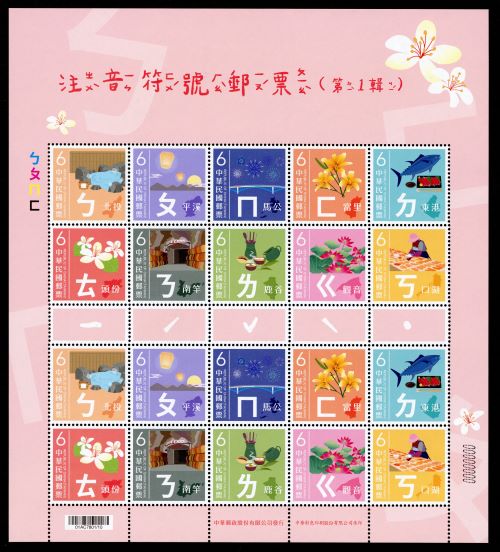
Here’s a companion image for a Ms. Huang.
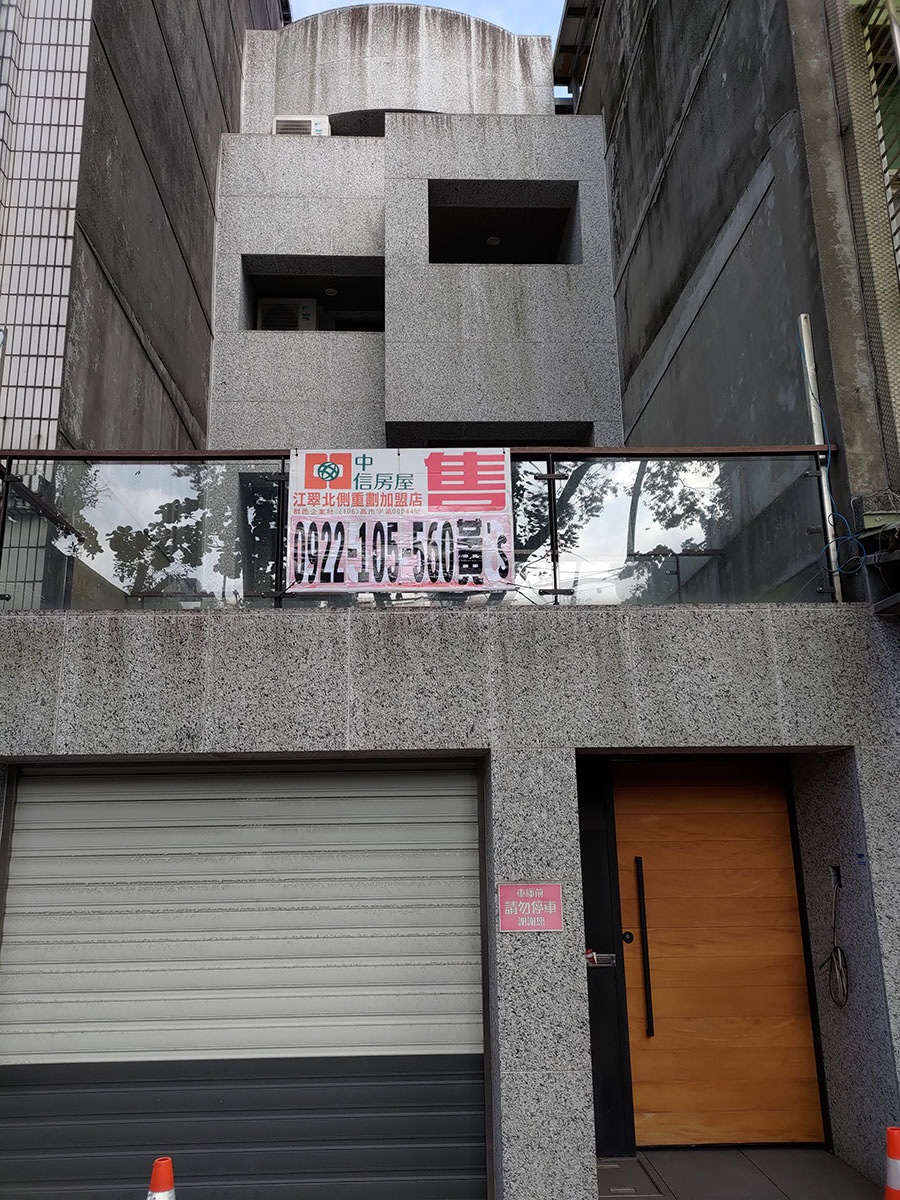
Here’s a companion image for a Ms. Huang.
Source: Lìyuàn tōngguò: yuánzhùmín shēnfen zhèngjiàn — kě zhǐ xiě pīnyīn zúmíng (立院通過:原住民身分證件 可只寫拼音族名), United Daily News, May 15, 2024
Further reading:
“Gōnglì yòu’éryuán bù jiāo Hànyǔ Pīnyīn, ér xiǎoxué yī-niánjí Hànyǔ Pīnyīn zhī jiāo yī dào yī gè bànyuè, háizi nányǐ gēnshang. Zhè yī wèntí pǔbiàn cúnzài, fǎnyìng qiángliè,” he said.
(“Public kindergartens don’t teach Hanyu Pinyin, and the first grade of primary school teaches Hanyu Pinyin for only one to one and a half months, making it difficult for children to keep up. The problem is widespread and the repercussions are strong.”)
The article does not mention this being in part a class problem, probably because the PRC supposedly does not have such things. But what has been happening is that parents with money tend to send their kids to private preschools where they learn Pinyin and otherwise get a head start on the school curriculum. Or the parents simply teach their youngsters themselves.
Students who don’t get this early boost often fall behind, which is a real problem for something so fundamental. As a result, Xu is proposing that schools spend a semester or even longer teaching Pinyin. The article, which is from a CCP mouthpiece and so should be regarded as representing an official position by at least some influential figures, calls this an easily overlooked but very important issue in basic education.
Intriguingly, Xu also mentions interspersing the teaching of Pinyin with “texts” (kèwén jiàoxué jiāochā jìnxíng / 課文教學交叉進行). The greater use of Pinyin texts in schools — if that’s indeed what is meant — could be a great boon to Pinyin education.
source:
Xú Xùdōng wěiyuán: jiànlì gèng fúhé értóng tèdiǎn de Pīnyīn jiàoxué móshì (徐旭東委員:建立更符合兒童特點的拼音教學模式), People’s Daily, March 5, 2024.
In a front-page column last week, the Asahi Shimbun said, “A draft report recently published by the Council of Cultural Affairs pointed out that the Hepburn system is more widely used than the Kunrei system, and it is expected that the notation will be adjusted to reflect this. It is surprising because the writing system has not changed for about 70 years, but if confusion can be avoided, the change is to be welcomed.”
Some examples of differences:
| Kunrei | Hepburn |
|---|---|
| Aiti | Aichi |
| Atugi | Atsugi |
| Gihu | Gifu |
| Hukusima | Fukushima |
| Sinzyuku | Shinjuku |
| Titibu | Chichibu |
| Tukizi | Tsukiji |
sources:
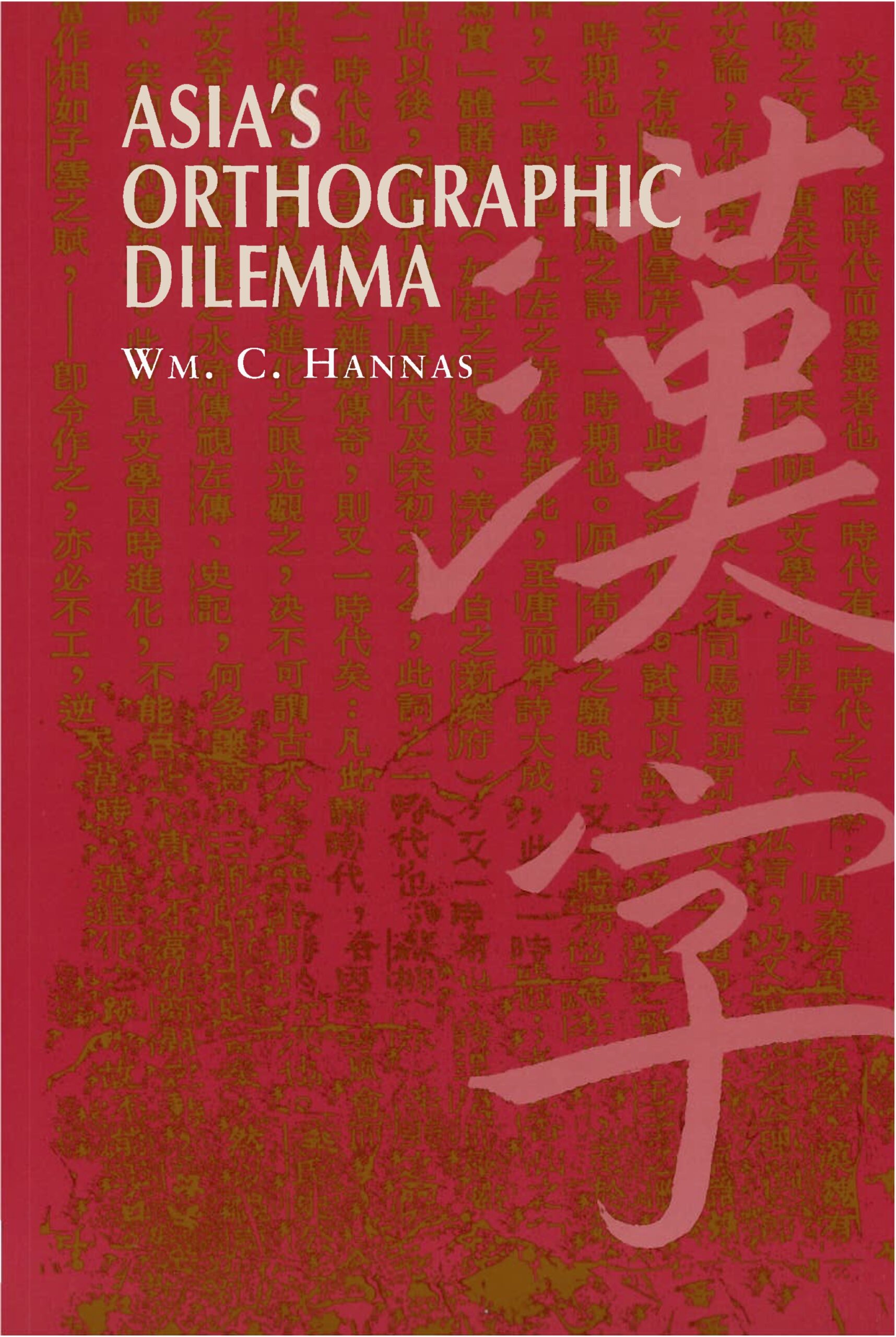

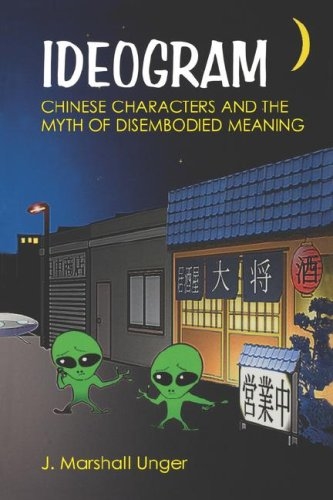
[Thanks to Victor H. Mair]
]]>General admission is 100 RMB.
]]>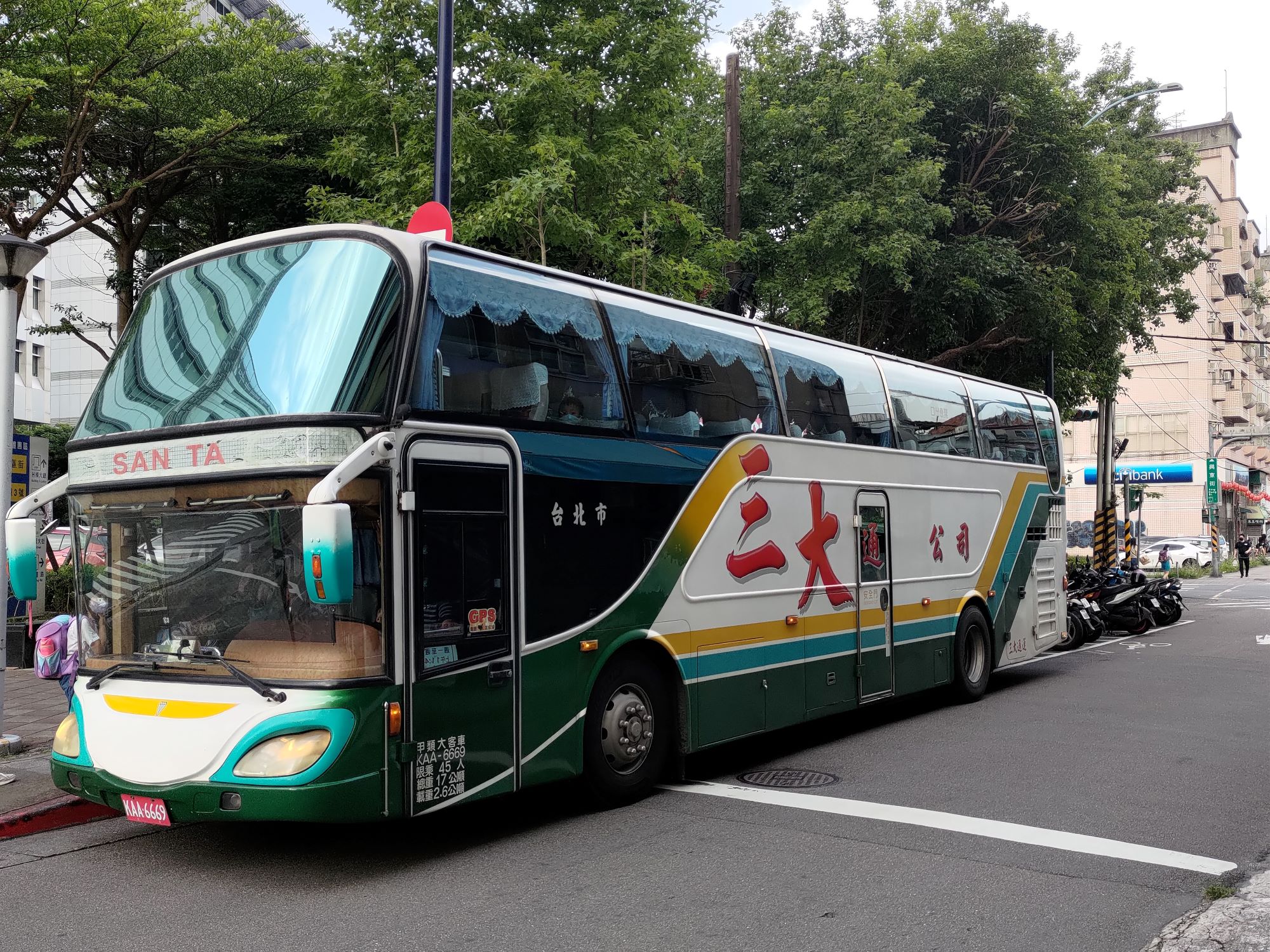
Santa’s in his bus and all’s right with the world.
Although coach buses in Taiwan often use the Gwoyeu Romatzyh romanization system, this bus uses “SAN TA” for “三大”, which is Wade-Giles.
]]>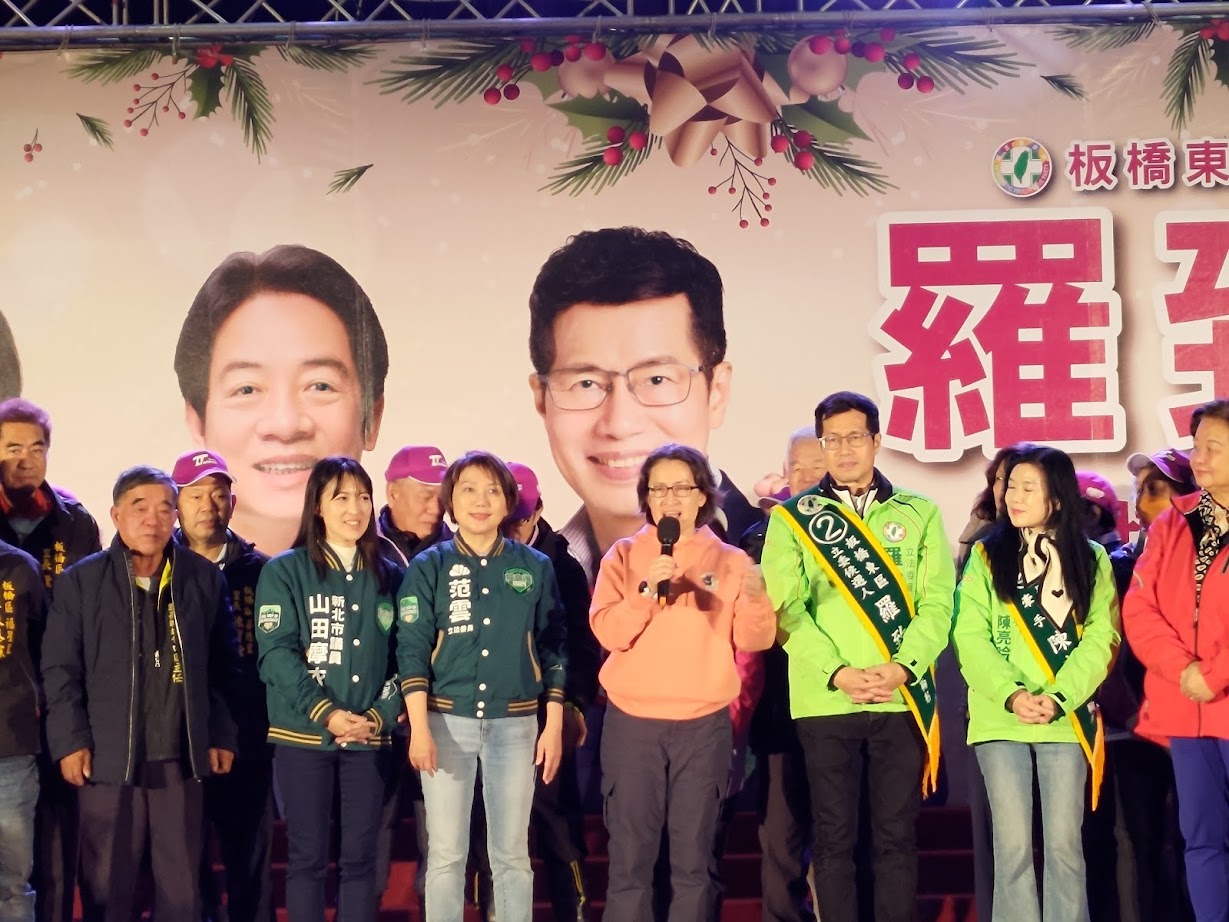
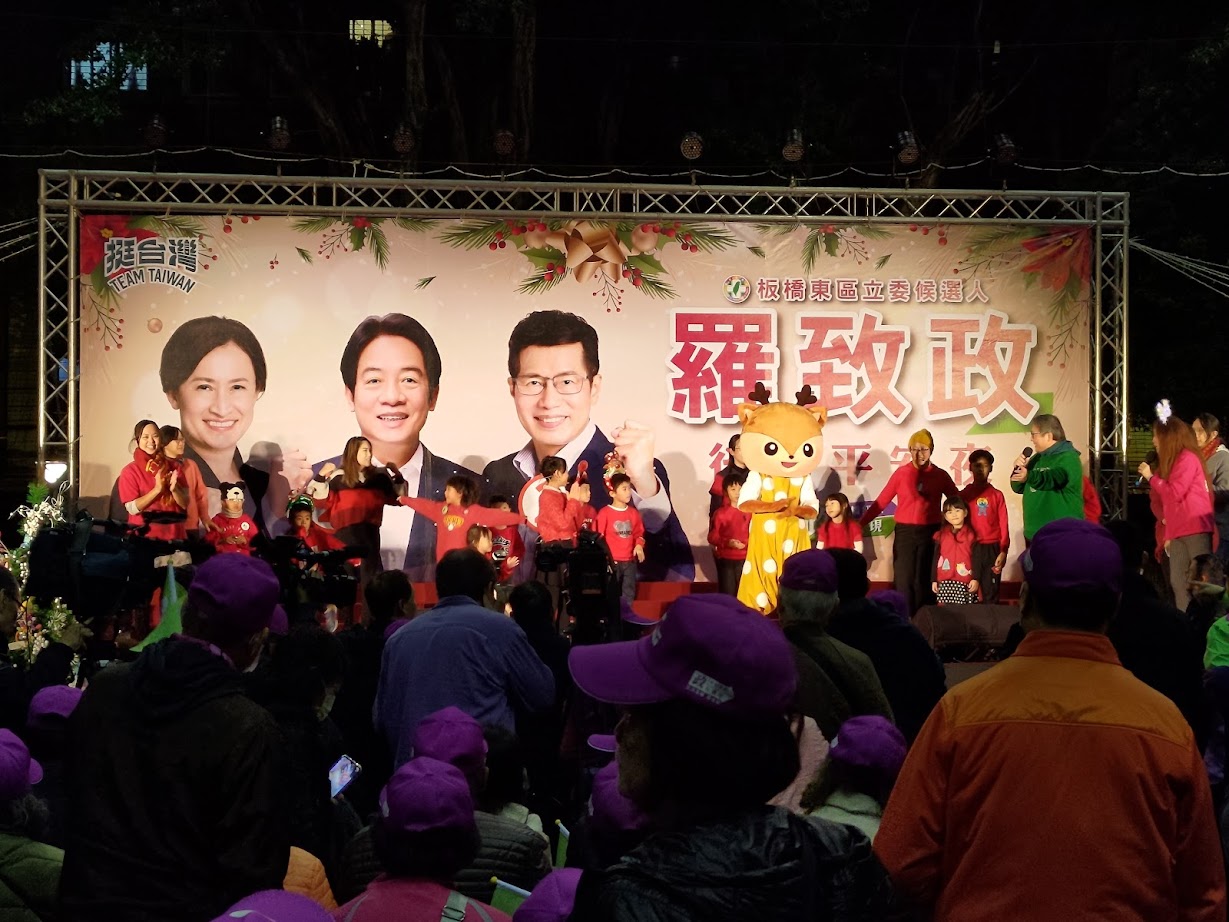
Earlier this evening I went to a rally for Hsiao Bi-khim, the Democratic Progressive Party’s candidate for vice president of Taiwan.
Most of the speakers at the rally, including Hsiao, spoke in Taiwanese, or in fluent code switching between Taiwanese and Mandarin. Hsiao, who spoke mainly in Taiwanese with some Mandarin mixed in, is more of a policy wonk than a tub-thumper. Although she struck me as better at campaign rallies than Tsai Ing-wen was earlier in her career, her remarks did include coverage of some things, important though they are, that aren’t typically used to boost crowd enthusiasm, such as working toward a tax treaty with the United States. But I was happy to hear her mention the importance of learning not just English but also keeping Taiwanese (Hoklo) and the languages of Taiwan’s indigenous peoples alive.
Part of the rally was in support of this, with a children’s group organized to help promote the speaking of Taiwanese among young people performing a skit in Taiwanese and then a rousing version of “Jingle Bells” in that language.
Hsiao is also a native speaker of English. I heard her speak (in English) about ten years ago and was impressed with her intelligence and thoughtfulness.
There has been some pushback against the new policy in San Francisco of not letting candidates for office use their own choice of Chinese name unless they can prove they’ve had the name since birth or that the name has been used publicly for at least two years. Those who advocated for the new rule may not have fully anticipated its impact.
“The regulation may unintentionally hurt American-born Chinese candidates who are making their first bids for office,” the San Francisco Standard reported. “Unlike more established politicos who are legacied in, they may not have used their Chinese names publicly, and if they were born in the United States, they also might not have any Chinese-language documents.”
Candidates are quoted as calling the policy “an incredible waste of time” and “absurd.” At least one press conference to protest against the new rule is planned.
Unless the policy is reversed, candidates must provide documentation in support of their self-submitted names before next Thursday.
source: Chinese American Candidates in San Francisco Outraged at Ballot Rule on Chinese Names, San Francisco Standard, December 15, 2023
]]>
San Francisco will begin its own enforcement of a 2019 bill that places restrictions on the use of self-submitted Chinese names (i.e., names as written in Chinese characters), requiring that candidates prove they’ve had the names since birth or that the name has been used publicly for at least two years.
All other candidates on the ballot will be assigned transliterated names (i.e., names that use Chinese characters according to rough their having at least rough equivalents in sound in Mandarin, Cantonese, or another Sinitic language).
Since 1999, San Francisco — whose [ethnic] Chinese population is about 21.4 percent of its population as a whole — has required ballots to include the candidates’ English names and their translated or transliterated names in Chinese characters….
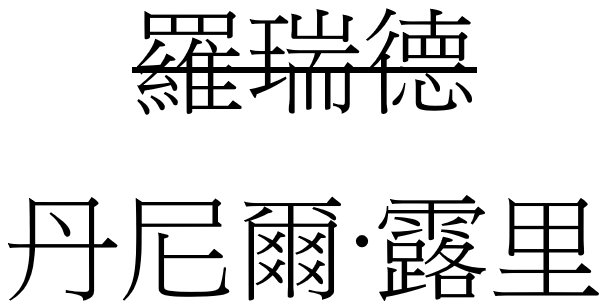
[C]andidate for mayor Daniel Lurie, “will likely be assigned a name, 丹尼爾·露里,” which “doesn’t have any meaning. It’s just an approximate pronunciation of his name in English: ‘DAN-knee-er LOO-lee.’”
Lurie had already given himself the name 羅瑞德, which means “auspicious” (瑞) and “virtue” (德), according to the [San Francisco] Standard. The Standard said this name is “widely publicized in the Chinese-speaking world,” but since he is a first-time candidate, if he can’t prove he has used the name for at least two years, it likely will not appear on the ballot in 2024.
Many established local public figures will be grandfathered in, since many will meet the two-year threshold already.
But then there’s this: San Francisco Supervisor Connie Chan, who led the push for the change, said, “Cultural appropriation does not make someone Asian…. There is no alternative definition to whether someone is Asian or not. It should be based solely on a person’s ethnicity and heritage. That’s what this law is about.”
That’s very different than a birth-name or two-year stipulation.
As real as cultural appropriation may be in some situations, wanting to base this “solely on a person’s ethnicity and heritage” seems to me problematic. I doubt Chan would argue that immigrants like herself who gain U.S. citizenship are not real Americans entitled to use Western names like “Connie.”
Then there’s the case of plenty of people whose ethnicity and heritage are not Chinese who live in Asia and have Chinese names, in many cases because they were required by government regulations. I’m one of those people. Although I’m unlikely to ever run for office in San Francisco and I’ve had my “Chinese name” a lot longer than two years, Chan doesn’t seem interested in granting any ground on this issue — at least not from what’s given in the brief quote.
source:
San Francisco targets non-Chinese candidates using Chinese names on ballots, The Hill, December 7, 2023
further reading:
SF politicians and Chinese names, Pinyin News, May 12, 2023
(photo by Savungaz Valincinan)
Here’s a ChatGPT translation of a story in the Liberty Times about this:
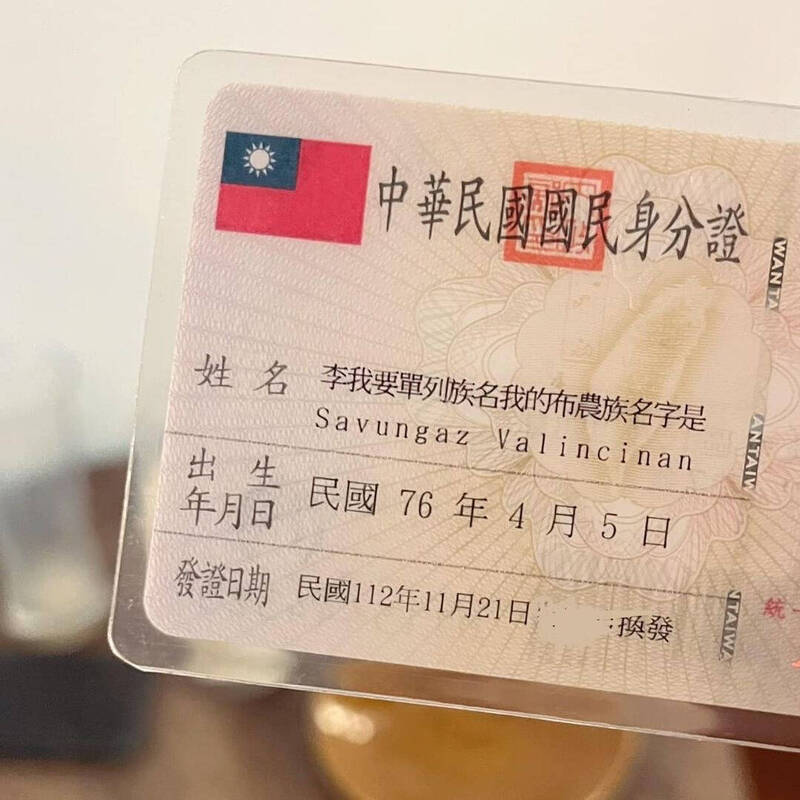
The registration of candidates for the 2024 legislative election concluded on the 24th. According to data from the Central Election Commission (CEC), there are a total of 10 candidates running for mountain indigenous legislator positions. One candidate stands out with a name that spans 34 characters, and it reads, “李我要單列族名我的布農族名字是Savungaz Valincinan,” making it the longest name among this year’s legislative candidates.
Following the successful administrative lawsuit regarding the “Administrative Appeal for Single Listing of Tribal Names on Indigenous Identification Cards” in early November, the New Taipei City Government Civil Affairs Bureau issued the first identification card with a single-listed tribal name. However, as this was a local “case remedy,” other indigenous individuals wishing to list only their tribal names are still unable to complete the process.
Savungaz Valincinan expressed that for this election, she chose not to use the transliteration of her Bunun tribal name in Chinese characters. Two days before registration, she officially changed her name at the household registration office to “李我要單列族名我的布農族名字是Savungaz Valincinan.”
Emphasizing that the name change is not a mere joke but a sincere and poignant appeal, Savungaz Valincinan questioned, “Why should such a small matter like adjusting administrative procedures make us shout so hard and still be unattainable?”
Other indigenous individuals have also inquired with local governments about listing only Romanized Pinyin for their names. However, according to the responses received, currently, there are only three options: traditional name transliterated into Chinese characters, traditional name transliterated into Chinese characters with Romanized Pinyin, and Chinese name alongside traditional name with Romanized Pinyin.
She urged that if the government continues to overlook the demands of indigenous people, and if she is fortunate enough to become a legislator in the future, every government official addressing her must recite the “demand for single-listing tribal names” every time until they genuinely amend the administrative procedures.
In the 2024 legislative election, aside from the 315 regional legislative candidates, there are 10 candidates for plain indigenous legislator positions and 10 candidates for mountain indigenous legislator positions who have completed their registrations.
For more about this general topic, please see Some Indigenous people in Taiwan want to drop their Chinese names: ‘That history has nothing to do with mine’, an excellent article by Stephanie Yang and David Shen (Los Angeles Times, May 2, 2023).
source: 34 zì! Míngnián dàxuǎn míngzi zuìcháng Lìwěi cānxuǎn rén — pàn zhèngfǔ zhòngshì dān liè zúmíng sùqiú (34字!明年大選名字最長立委參選人 盼政府重視單列族名訴求), Liberty Times, November 26, 2023.
further reading: Savungaz Valincinan Facebook page.
]]>This post provides a look at the some of the numbers from the most recent report by the Modern Language Association, focusing especially on the case of Chinese/Mandarin, with some other languages (esp. Japanese) tossed in by way of comparison.
Among the fifteen most commonly taught languages other than English, only three — Korean, American Sign Language, and Biblical Hebrew — showed gains, at 38.3%, 9.1%, and 0.8%, respectively.
Thus, Mandarin and Japanese are among those in decline. Although in total enrollments Mandarin is now ahead of Italian, and Japanese has moved ahead of German, that’s simply because those two Asian languages didn’t fall as far as those two European ones.
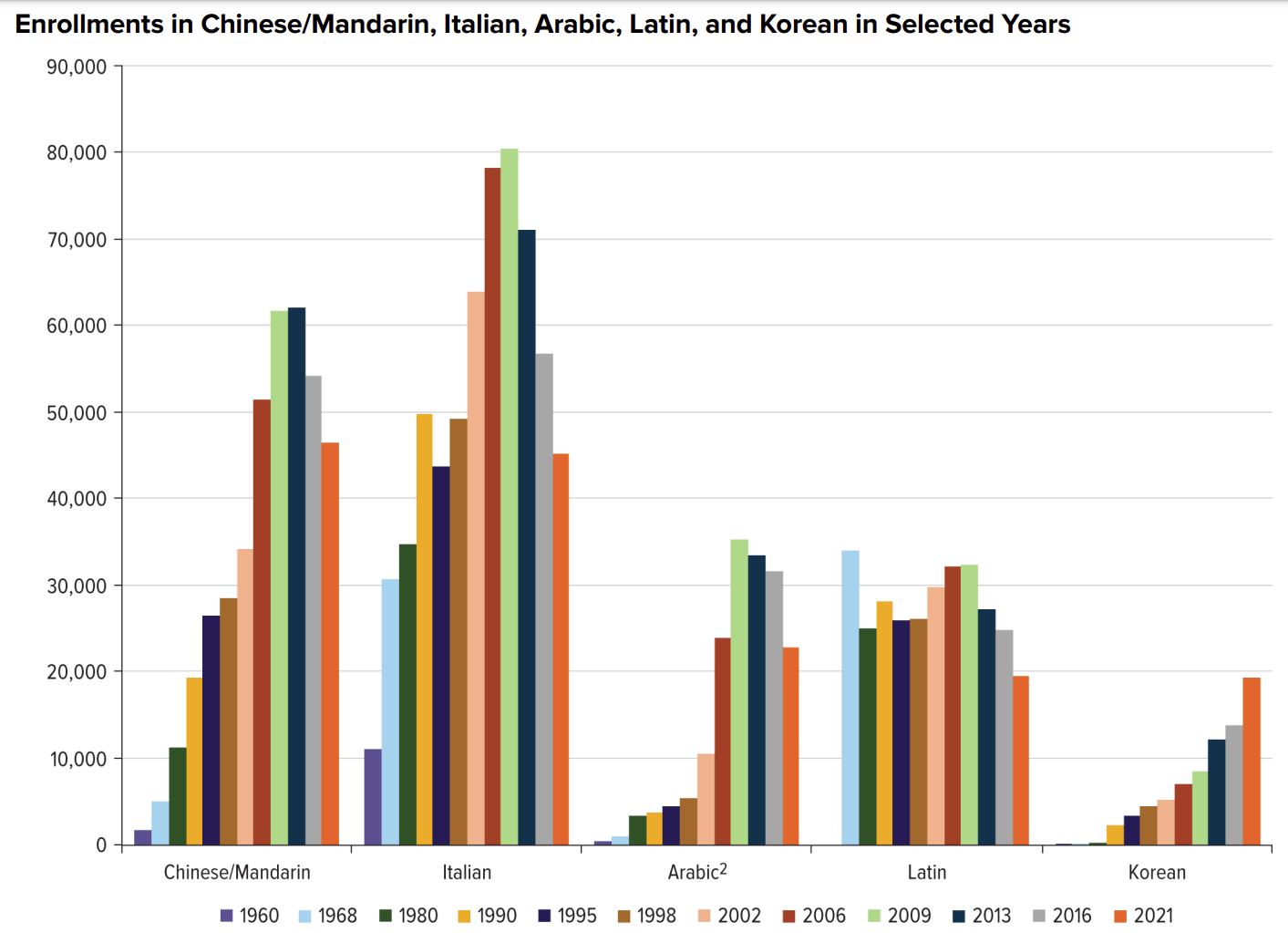
(source: MLA report)
From the MLA report:
Chinese/Mandarin enrollments … showed steep declines…. Chinese/Mandarin enrollments fell 14.3% overall and 23.9% at two-year schools, 12.5% at four-year schools, and 29.5% at the graduate level…. Chinese/Mandarin enrollments have been dropping at two-year institutions since 2009, and at four-year institutions since 2013. Graduate enrollments in Chinese/Mandarin have remained fairly steady for the last twenty years; the drop from 2016 to 2021, from 1,266 to 892, is the first time graduate enrollments in Chinese/Mandarin have fallen below 1,000 since 2002.
From the five uses of “Chinese/Mandarin” in the previous paragraph, longtime readers of Pinyin News will note that the MLA acted upon my earlier recommendation to aggregate those two terms rather than treat them separately. But don’t worry: the MLA report doesn’t give the wordy “Chinese/Mandarin” every time in its report. (Although in general use I prefer “Mandarin,” in this post I often use “Chinese” simply to aid people making Google searches.)
Now for some graphs and tables, some directly from the MLA report, others I made using the MLA’s data.
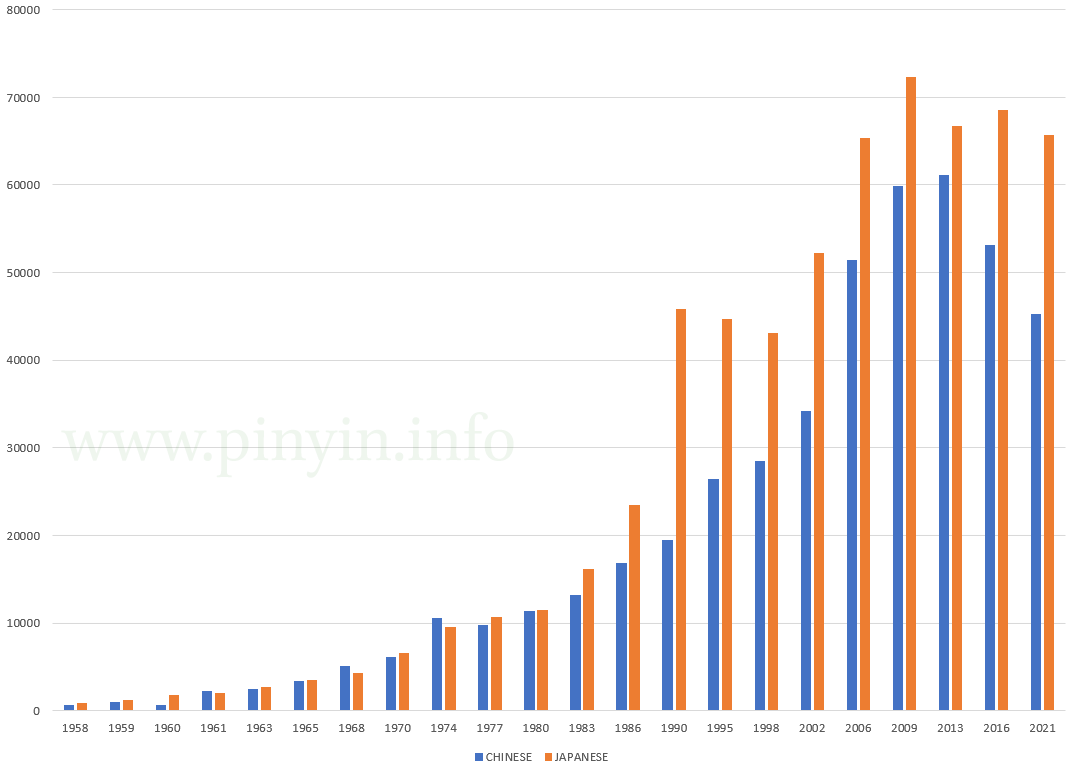
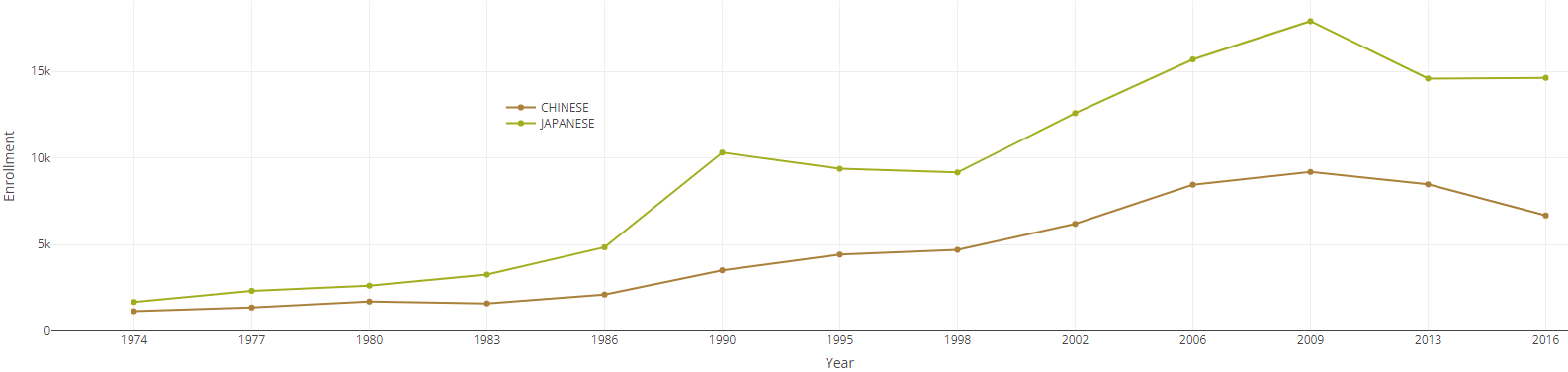
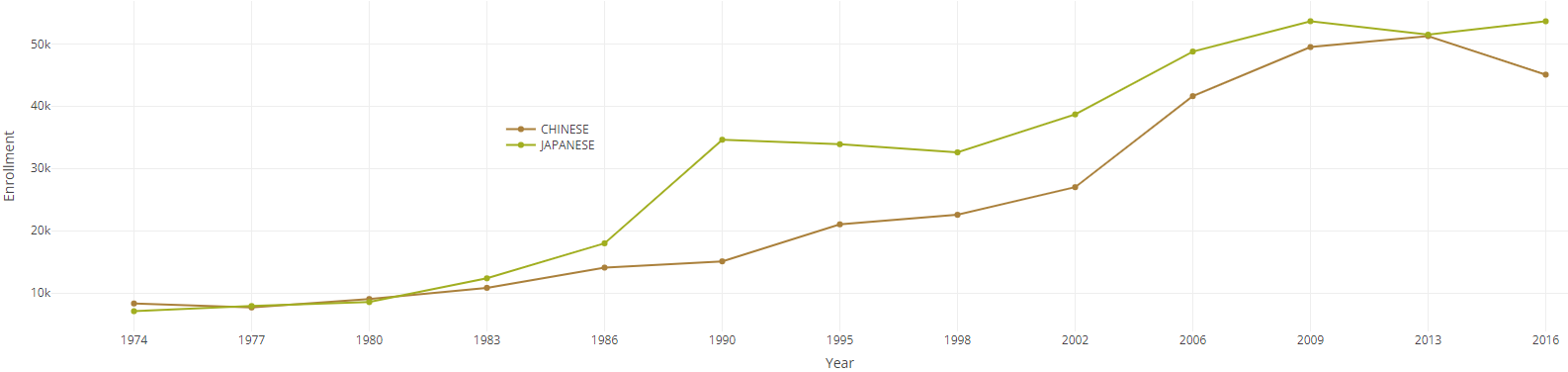
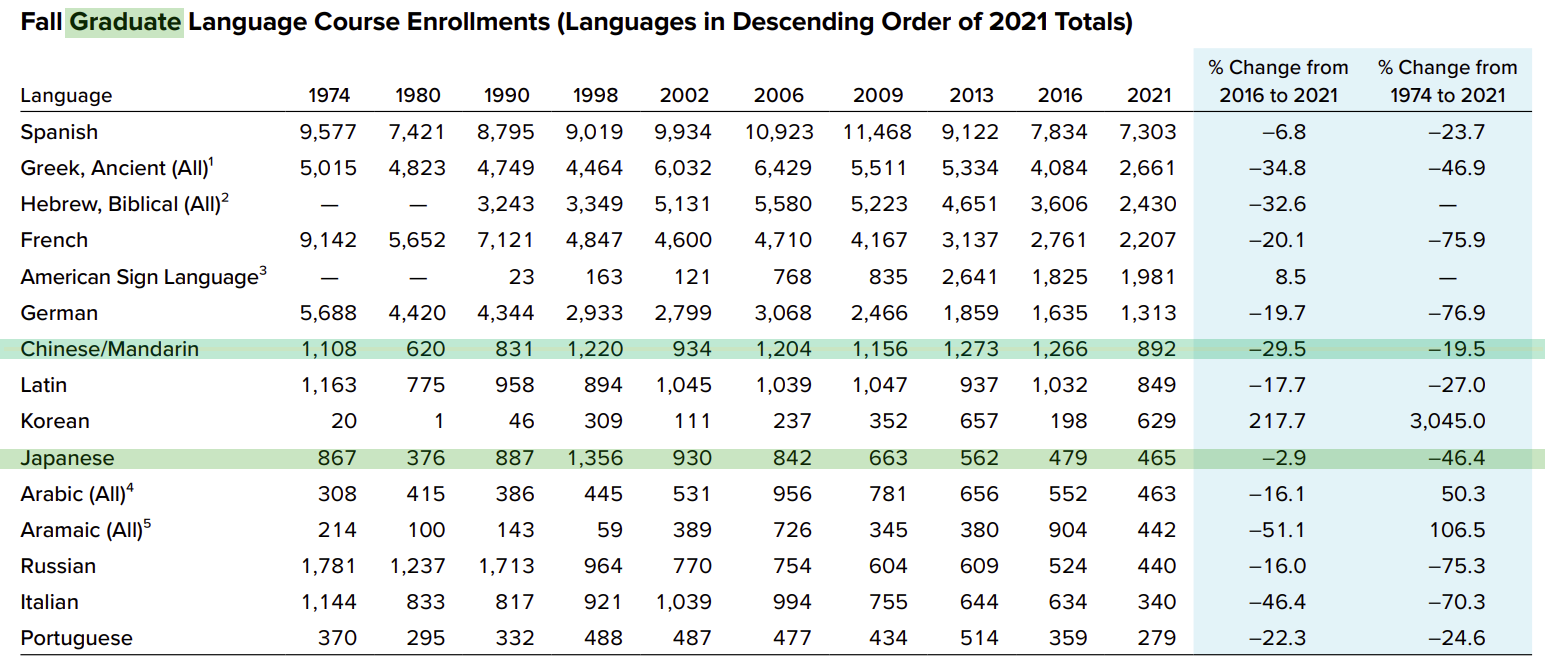
In one encouraging sign for Mandarin, it had a 3:1 ratio of introductory to advanced undergraduate enrollments, making it one of just five languages that had a 4:1 or better ratio, along with Biblical Hebrew (2:1), Portuguese (3:1), Russian (3:1), and German (4:1). This is important because on average it takes more time for native speakers of English to reach the same level in Mandarin than they might achieve in, say, two years of French.
Also, although the number of enrollments is down for Mandarin, that language beat the reduction trend by having a slight increase in the number of institutions offering it at the graduate level: 54 in 2021, up from 52 in 2009. On the other hand, Chinese enrollments overall were reported by 105 fewer institutions in the survey.
As this table from the MLA report shows, Mandarin programs around the United States have been decreasing, stable, or increasing at about the same rates as programs for other foreign languages — which is to say, mainly decreasing. Japanese, however, is continuing to do well given the recent environment.
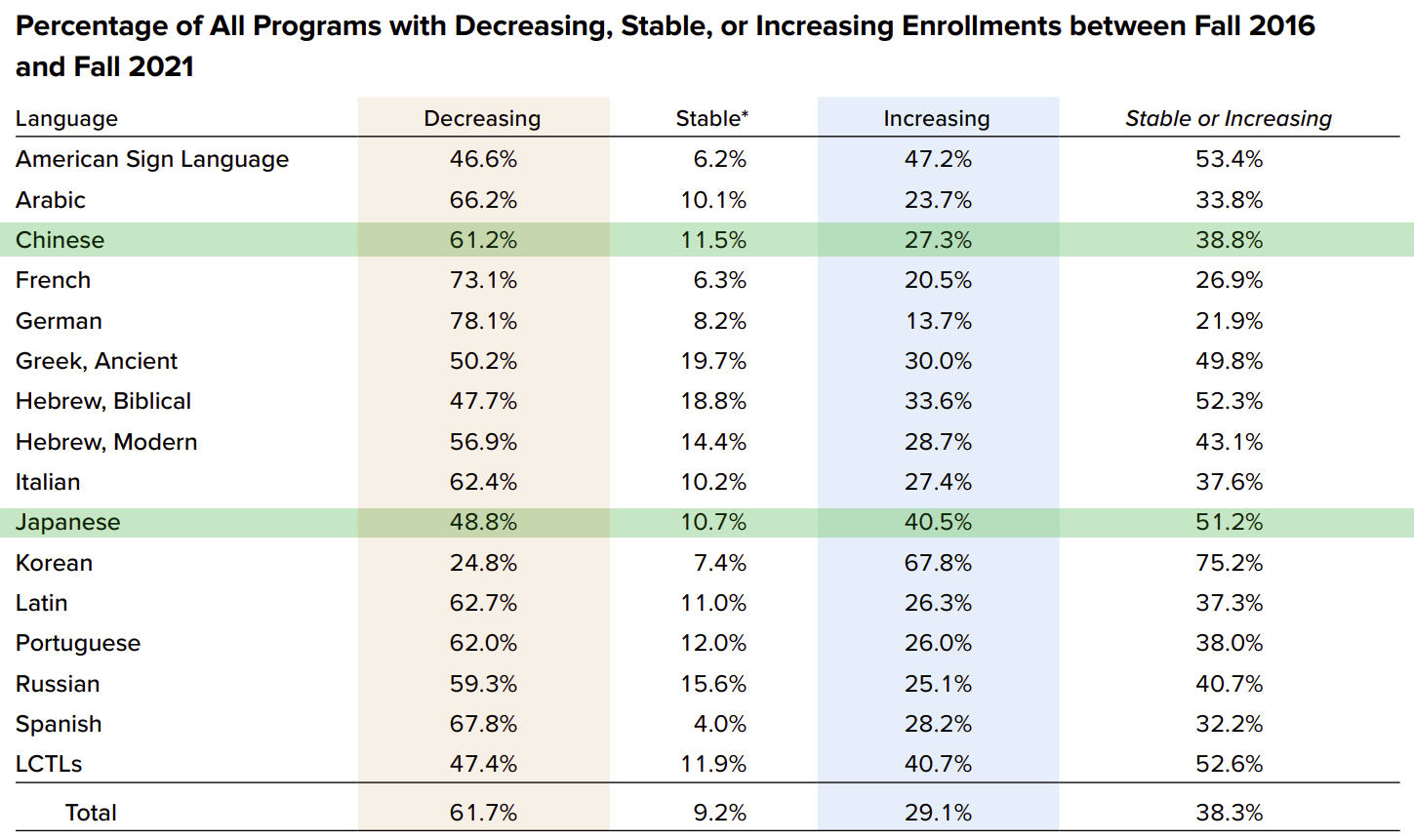
The figures are about the same for introductory programs, so I won’t bother to reproduce that table (12b).
sources:
Further reading:
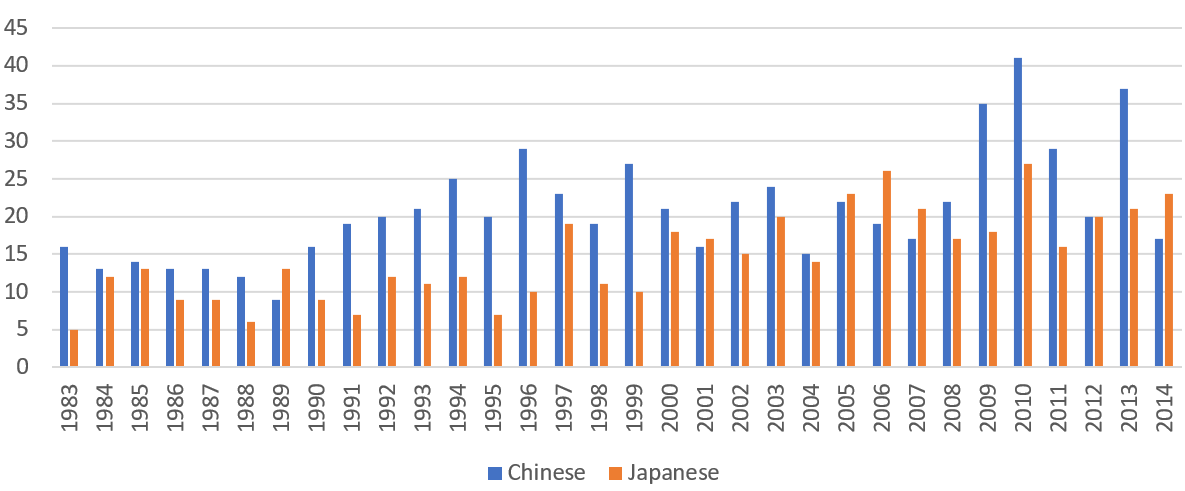
As you can see, in most years more doctorates were awarded in Chinese than in Japanese. The total doctorates over the covered period are 666 for Chinese and 471 for Japanese. By way of comparison, during the same period 870 doctorates were awarded in the United States in Italian.
Interestingly, undergraduate enrollments are typically higher in Japanese than in Mandarin, the reverse of the situation with doctorates.
Although the most recent report on this was issued way back in 2016, recent trends in foreign language enrollments in U.S. postsecondary institutions (to be detailed in a later post) show a steep decline that may well be reflected in the number of people earning doctorates in Mandarin and Japanese in U.S. universities.
source: Report on the Survey of Earned Doctorates, 2013–14, MLA Office of Research, December 2016
further reading:


sources:
]]>This presidential campaign we have several examples of English slogans, with half of them based on the candidate’s name.
My previous post showed a poster for Terry Gou (Hanyu Pinyin: Guo Tai-ming) with the slogan of “GOOD TiMING.” (His Mandarin given name, “Tai-ming,” is largely homophonous with the English word “timing.”) The other day I came across a same-same but different poster, this latter one in Zhonghe.
The Zhonghe one, though, has the less successful variant English slogan of “GOOD TiMEING” (with an e).
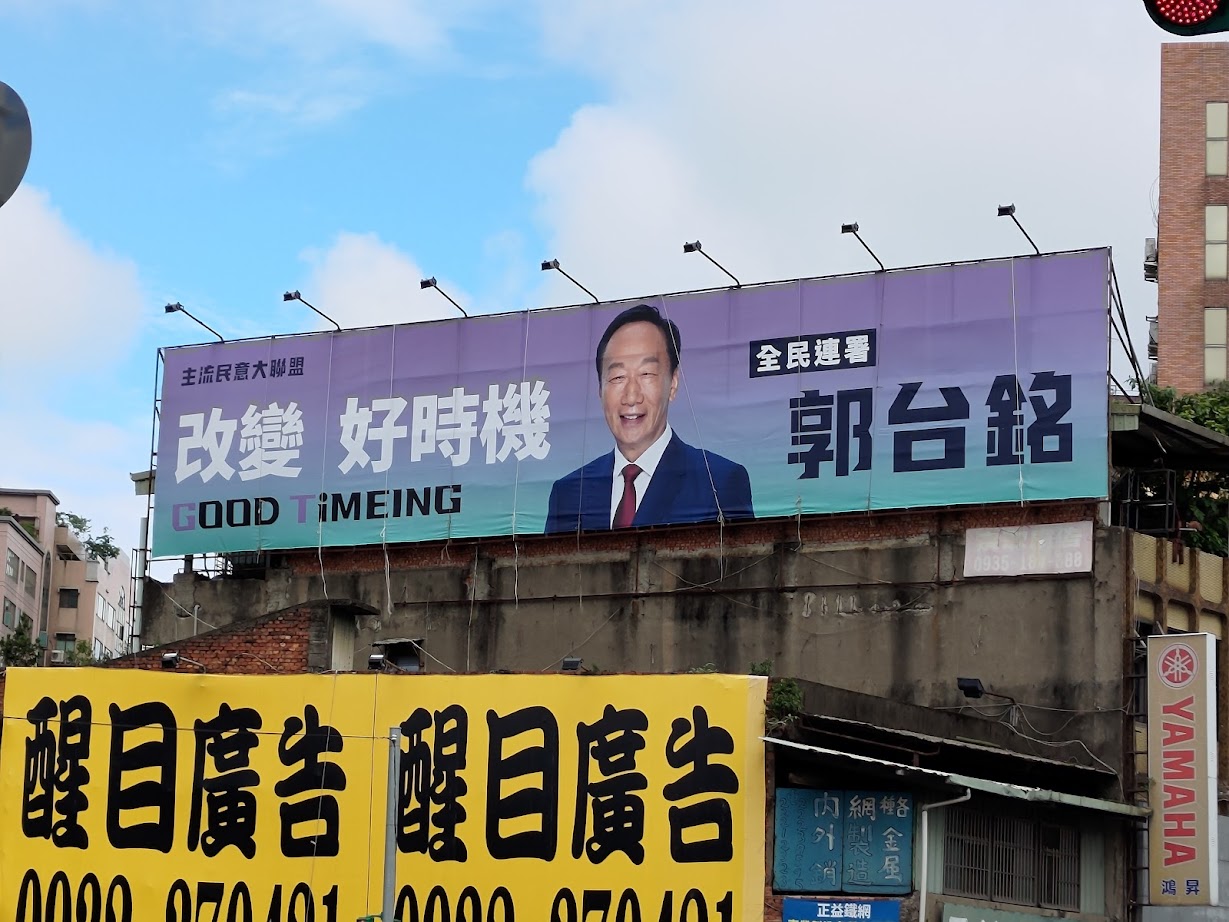
Gou’s campaign website currently has the e-less version, as does his recently released (and soon withdrawn) ill-advised video, so it would appear that the “TiMEING” version is older, as is the inclusion of Mandarin (改變 好時機 / gǎibiàn — hǎo shíjī / change — good opportunity). Yesterday I also saw the e-less version on the side of a bus.
FWIW, using English’s -ing ending with Mandarin has already been around for several election cycles.
The campaign for Ko Wen-je (Hanyu Pinyin: Ke Wen-zhe) is employing the vaguely positive-sounding but clunky English slogan of “Keep Promise”, which is meant to echo his nickname of “Ko P” (from Professor Ko). Ko’s own level of English is surely better than that, but he used it anyway.
The candidate whose personal command of English is strongest might be the Harvard-educated Lai Ching-te (Hanyu Pinyin: Lai Qing-de) of the DPP. His English slogan, however, does not evoke the sound of his name, likely because his family name of “Lai” sounds very much like the English word “lie.” Instead, he has “TEAM TAIWAN”, along with the related Mandarin of 挺台灣 / tǐng Táiwān. Ting (endure, stand) and team are phonetically similar though certainly not identical.
The remaining presidential candidate of note, Hou Yu-ih (侯友宜) of the Kuomintang, does not appear to have an English slogan. Incidentally, I have no idea how he came up with the romanization of his name. It doesn’t match any of the main romanization systems in Taiwan for Mandarin, nor is it an English-friendly ad hoc version. In Hanyu Pinyin, his name would be written Hou You-yi / Hóu Yǒu-yí.
I have no idea how good his English might be — not that it’s a job requirement. When I was introduced to him about five years ago, he didn’t bother to speak to me in any language beyond perhaps a cursory ni hao.
]]>